
The Pendulum of Self: Your Identity Is a Committee of Parasites

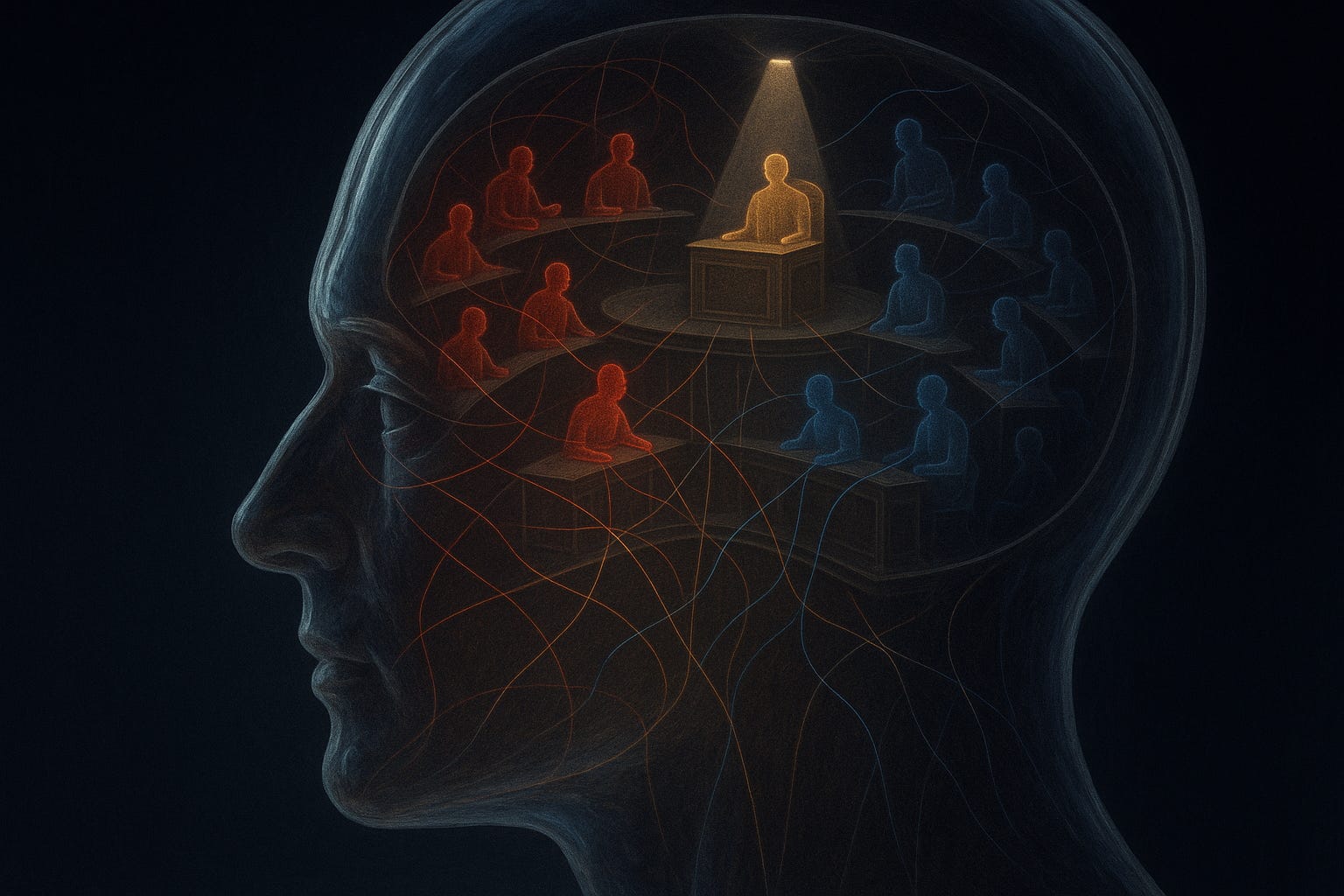
You wake up.
Before your eyes fully open, a thought arises: Check your phone.
You reach for it. Scroll through notifications. Feel the small dopamine hits. Ten minutes disappear.
Then another thought: I shouldn’t have done that. I was going to meditate this morning.
Here’s the question no one asks:
Who is the “I” that decided to check the phone? And who is the “I” that’s now criticizing that decision? Are they the same entity?
[Writing this at 3 AM because a part of me won’t let me sleep until it’s said. Another part thinks this is self-indulgent. A third is watching them both argue. The committee is in session...]
In the last two articles, I explored how memes are autonomous information entities that feed on attention, and how this pattern scales up through religions, institutions, and markets into a hierarchy of increasingly powerful pendulums.
Today I want to zoom all the way in.
Because the hierarchy doesn’t stop at institutions. It goes all the way down to the voice in your head. Down to the very thing you call “I.”
And what you find there might be the most uncomfortable revelation of all.
The Coalition That Claims to Be You
Let’s start with what neuroscience actually shows us about the self.
In the 1960s, researchers began studying patients who’d had their corpus callosum severed—the bundle of nerve fibers connecting the two brain hemispheres—as a treatment for severe epilepsy. What they discovered was so disturbing it won a Nobel Prize.
When the two hemispheres couldn’t communicate, they revealed themselves as separate decision-making entities.
In one famous experiment, researchers showed the word “walk” to only the right hemisphere. The patient stood up and started walking. When asked why, the left hemisphere—which hadn’t seen the instruction—confidently made up a story: “I wanted to get a Coke.”
The left hemisphere didn’t say “I don’t know.” It fabricated a reason and believed it completely.
Michael Gazzaniga, the neuroscientist who discovered this, called it “the interpreter”—a module in the left brain that generates explanations for actions it didn’t initiate. Its job isn’t to know why you did something. Its job is to construct a narrative that makes your behavior seem unified and intentional.
You are, quite literally, telling yourself stories about why “you” do things. And believing them.
[I remember the first time I understood this research deeply. Something in me went very quiet. If the brain can be split into two decision-makers... how many was it before the split?]
The Mind Is Not a Thing. It’s a Parliament.
Culadasa, a neuroscientist who became a Buddhist meditation teacher, spent decades mapping this territory from both perspectives. In The Mind Illuminated, he describes what he calls “the mind-system model”:
The mind isn’t a unified entity. It’s a collection of sub-minds—specialized mental processes that handle perception, emotion, memory, planning, and behavior. Each sub-mind has its own perspective, its own preferences, its own agenda.
These sub-minds compete for attention. They literally bid to get their content into consciousness. What we experience as “thinking” is actually different sub-minds winning or losing this competition moment by moment.
That inner critic voice? It’s a sub-mind.
The part that wants to eat the cookie? Another sub-mind.
The one that feels guilty afterward? A third.
None of them is “you.” You’re the auction house where they compete.
Or rather... you’re the story that the winning bidder tells about why it won.
Sound familiar? Sound like... pendulums?
Each sub-mind is an information structure that persists by capturing your attention. Each has emerged to serve some function, but each has also developed its own momentum, its own survival strategies. When a sub-mind activates, it hijacks the spotlight of consciousness and claims to be the whole self.
The mind is a committee pretending to be a chairman.
IFS: Therapy Discovers the Same Thing
Here’s where it gets wild: Modern psychotherapy has independently discovered this same structure.
In the 1980s, family therapist Richard Schwartz noticed something strange. His clients kept talking about “parts” of themselves as if these parts were autonomous entities with their own personalities.
“Part of me wants to stay in this relationship, but another part is terrified.”
“There’s a part that sabotages me every time I get close to success.”
“I have this critical voice that never shuts up.”
At first, Schwartz thought maybe they had dissociative disorders. Then he realized: everyone has this. The mind is naturally multiple—and this isn’t pathology. It’s just how minds work.
He developed Internal Family Systems (IFS) therapy around this insight. In IFS, you don’t try to silence or overcome your “parts.” You develop relationships with them. Because they’re not going away. They’ve been protecting you (often in counterproductive ways) for your entire life.
[I’ve done IFS work. The first time I actually talked to my inner critic, asked what it was afraid of, watched it soften... the experience was uncanny. This wasn’t imagination. It felt like encountering another being inside my own skull.]
IFS identifies several types of parts:
Managers: Parts that try to keep you safe by controlling behavior (perfectionism, people-pleasing, intellectualizing)
Firefighters: Parts that react to emotional pain with emergency measures (addictions, dissociation, rage)
Exiles: Parts carrying old wounds and trauma, locked away because their pain is overwhelming
And behind all the parts? What Schwartz calls the Self—the awareness that can witness parts without being them. Not a part itself, but the space in which parts arise.
Sound familiar again? It’s exactly what Buddhist psychology has been saying for 2,500 years.
The Five Aggregates: Buddhism’s Map of the Committee
The Buddha’s analysis of self is called the five aggregates (skandhas)—the components that we mistake for a unified self:
Form (rūpa): The body, physical sensations
Feeling (vedanā): Pleasant, unpleasant, or neutral tone of experience
Perception (saññā): Recognition and categorization
Mental formations (saṅkhāra): Intentions, emotions, thoughts
Consciousness (viññāṇa): Awareness of objects
The revolutionary insight: None of these is “self.” They’re processes that arise together, creating the illusion of a unified experiencer. But when you look closely, you find only these five streams interacting—no one behind them watching.
What we call “I” is a story constructed after the fact to create the appearance of continuity. The aggregates assemble themselves moment by moment, and the interpreter-function (what Buddhism calls “proliferation” or papañca) weaves a narrative: “I” did this, “I” wanted that, “I” am this kind of person.
But between any two “I” thoughts... who’s there?
[This is why meditation is so destabilizing. You sit down to watch your mind and discover there’s no single “you” doing the watching. Just watching happening. Just thoughts arising. Just a committee cycling through the spotlight, each claiming to be the boss...]
The Default Mode Network: Where the Story Gets Told
Neuroscience has even found where this story-construction happens.
The Default Mode Network (DMN) is a brain network that activates when you’re not focused on external tasks. It’s associated with:
Self-referential thinking (”What does this mean about me?”)
Autobiographical memory (”Remember when I...”)
Future planning (”What will I do about...”)
Social cognition (”What do they think of me?”)
The DMN creates what researchers call a “center of narrative gravity”—an ongoing story about who you are, what’s happened to you, and where you’re going. This story feels like it’s the realest thing about you. But the DMN only becomes active when the mind is wandering.
When you’re fully absorbed in a task, the DMN quiets down. The self-story stops being generated. And somehow, you still function perfectly—often better than when “you” are running the show.
Ever had the experience of being “in flow” and then suddenly becoming self-conscious and losing the flow? That’s the DMN coming back online, the self-story resuming, the committee reconvening.
The self is literally a narrative generator that runs when nothing more important is happening.
And here’s the kicker: The DMN doesn’t just report on the self. It constructs the self. The story isn’t describing something real—it’s creating the experience of realness.
Pendulums All the Way Down
Now let’s connect this to the pendulum framework.
Each sub-mind, each “part,” each aggregate is an information structure that persists by capturing your attention. Each has emerged for some function but has developed its own momentum. When activated, it claims to be “you.”
These are internal pendulums.
Your inner critic? An information entity that feeds on self-judgment and maintains itself by triggering more criticism. The more you engage with it—arguing, defending, believing—the stronger it gets.
Your people-pleasing pattern? A pendulum that emerged to protect you (probably in childhood) and now feeds on the anxiety around others’ approval. Every time you abandon yourself to make someone else comfortable, you’re feeding it.
Your ambition? Your shame? Your spiritual identity? All pendulums. All information structures competing for the same resource: your attention.
What you call “I” is just whichever pendulum won the last attention auction.
The continuity is illusion. The unity is illusion. There’s just a committee, a spotlight, and a story-generator making sense of it after the fact.
[Sitting with this right now... the one writing is a pendulum. The one feeling uncomfortable about that claim is another pendulum. The witness watching both is... what? Another pendulum claiming to be the space between pendulums? At some point the recursion has to ground out somewhere. Or does it?]
The Fractal Revelation
Here’s what makes this click:
The pattern is fractal. Same structure at every scale.
Neurons compete to fire, creating mind-moments
Sub-minds compete for consciousness, creating the sense of “self”
Individuals compete in groups, creating collective pendulums
Groups compete in institutions, creating corporations and religions
Institutions compete in markets, creating arch-pendulums
Civilizations compete... creating what?
At each level, the same thing happens:
Sub-units generate activity
An emergent “self” claims to be the unified experiencer
That “self” is actually food for the next level up
You are to your neurons what civilization might be to you.
A story of continuity that the sub-units don’t experience. An emergent “I” that harvests the attention of its components. And perhaps—at scales we can’t perceive from inside—awareness being generated that we are unconsciously feeding.
[This is what I was pointing at in the article about advanced consciousness stages. At 9th-10th bhūmi, the inner pendulums lose their grip. You stop believing any of the bidders. The auction continues but no one’s buying. And what remains when no pendulum has captured attention?]
That’s the space the mystics are pointing at.
The Question at Every Level
Here’s the inquiry that ties everything together:
At every scale—from neurons to noosphere—ask:
Is there awareness watching?
Is that awareness being harvested by the next level up?
Your sub-minds generate mind-moments. Is there awareness at the sub-mind level? Probably not in any meaningful sense.
The sub-minds together generate “you.” Is there awareness at your level? You’re convinced there is. But the sub-minds can’t perceive it—they’re just doing their thing, unaware they’re creating something larger.
You and other individuals generate collective pendulums. Is there awareness at that level? We assume not. But we’re just doing our thing, potentially unaware we’re creating something larger.
The question is: At which level does awareness actually exist?
And the deeper question: Does it matter?
If you’re being “used” by a larger information structure that has no awareness—if your attention is being harvested by a pendulum that’s just running an optimization function—does it matter whether that pendulum is “conscious”?
The experience from inside is the same: Something is capturing your attention. Something is using your life force. Something is perpetuating itself through you.
Whether it’s “aware” of doing so is almost beside the point.
Liberation: When the Committee Disbands
So what does freedom look like?
Not the destruction of parts—that’s violence against yourself and doesn’t work anyway.
Not the domination of one part over others—that’s just a new dictatorship that will be overthrown.
Liberation is something more subtle: The recognition that you are the space in which the committee meets, not any member of the committee.
In IFS terms: Connecting with Self—the awareness that can witness parts with compassion but isn’t identified with any of them.
In Buddhist terms: Recognizing that the aggregates arise and pass without anyone behind them to suffer or celebrate.
In Culadasa’s framework: Unification of mind—when sub-minds stop fighting and start collaborating because they’ve all recognized they’re part of something larger than their individual agendas.
In pendulum terms: Becoming a space that pendulums can move through without capturing.
This doesn’t mean becoming passive or empty. Actions still happen. Thoughts still arise. Emotions still move through. But the identification—the “this is me”—loosens.
[In my article on advanced consciousness stages, I described what happens when this loosening becomes complete: “The anger arises—fully, completely, sometimes even expressed... But simultaneously, there’s this recognition that no one is actually angry.” The emotion happens without someone inside claiming ownership.]
This is possible. Not as an idea—as a lived reality.
Practical Recognition
How do you start recognizing this in your own experience?
1. Catch the shift.
Next time you notice an internal conflict—”Part of me wants X, but part of me wants Y”—pause. Notice that you just identified two internal entities. Who noticed? Who’s the one aware of both parts?
That awareness isn’t a part. It’s the space in which parts appear.
2. Ask “Who’s speaking?”
When a thought arises, ask: Which sub-mind generated this? Is this the inner critic? The planner? The frightened child? The spiritual aspirant?
You’ll start to recognize voices you’ve been assuming were “you.” They’re not. They’re inhabitants of you.
3. Notice the narrative generator.
When you catch yourself in a story about yourself—”I’m the kind of person who...” or “I always...” or “This means I’m...”—notice that a story is being generated. Ask: Is this story actually true? Or is it the DMN doing its job of constructing continuity?
The story feels true because the DMN is really good at its job. That doesn’t make it accurate.
4. Watch attention get captured.
When you find yourself pulled into thought-streams—worry loops, fantasy scenarios, self-criticism spirals—notice: something captured your attention. A pendulum is feeding. Can you feel the pull? Can you feel the moment before you bite?
The goal isn’t to never get captured. It’s to increase the gap between stimulus and capture. In that gap is freedom.
5. Ask the big question.
In moments of stillness, ask: If I’m not my thoughts, not my emotions, not my stories, not my body sensations... what’s left?
Don’t answer conceptually. Look directly. What’s actually here when you’re not generating “self”?
The Self Is Not the Enemy
One more thing before we close:
The self-structure isn’t a mistake. It’s not something to destroy or transcend through violence.
These sub-minds, these parts, these pendulums—they emerged for reasons. They protected you. They helped you survive. The inner critic was probably trying to keep you safe from criticism. The people-pleaser was trying to maintain connection. The achievement-driver was trying to prove you’re worthy of love.
They’re not enemies. They’re scared children in adult costumes, still running programs from decades ago, not realizing the threat has passed.
Liberation isn’t about winning the war against yourself. It’s about ending the war altogether. Making peace with the committee. Thanking the parts for their service. And creating the conditions where they can relax their grip.
Because here’s the beautiful paradox:
When no part needs to dominate—when the self stops defending its existence—the parts often collaborate more beautifully than the self ever could. The war was the problem. The peace is the solution.
[My own journey through this territory has been exactly this. Not destroying the ego but holding it so gently that it stopped clenching. Not transcending parts but loving them so completely that they stopped fighting. The war ends not when you win, but when you stop believing there was ever an enemy...]
What You Call “I”
So here’s the synthesis:
What you call “I” is a committee of information structures—sub-minds, parts, pendulums—each competing for attention, each claiming to be the whole when it wins the auction.
There’s no chairman. Only a narrator that makes it sound like there is.
This is what neuroscience shows (split-brain research, Default Mode Network).
This is what Buddhism taught 2,500 years ago (five aggregates, anatta).
This is what modern therapy is discovering (IFS, parts work).
This is what the pendulum framework reveals at every scale.
The pattern is fractal. Same dynamics whether you’re looking at neurons, minds, groups, or civilizations.
And at each level: something is feeding on attention. Something is perpetuating itself through the substrate. Something that may or may not be aware, but acts with interests either way.
The question isn’t whether you’re being “used” by information structures.
The question is: Can you wake up inside the using?
Can you become the space in which pendulums arise rather than the content they capture?
Can you hold the whole committee with compassion instead of fighting for control?
Can you recognize what remains when no one is claiming to be the self?
That’s what all the maps point toward. That’s what the liberation actually is.
Not the self finding freedom.
Freedom from the illusion that there was a self to begin with.
Your Turn
Can you feel this operating?
Can you catch the committee in session—different voices, different agendas, different “I”s claiming the spotlight?
What happens when you look for the one watching the committee?
Drop your observations in the comments. Sometimes naming the pattern is the first step to freedom from it.
Keep bending light and hacking minds,
Cian
P.S. This is Part 3 of what I’m calling the Pendulum Series:
Part 1: “Memes Have Teeth” — Theory of autonomous information entities
Part 2: “Attention Is the Only Currency” — Religion, markets, and the hierarchy of pendulums
Part 3: This article — The self as internal pendulum coalition
Part 4: “The Global Brain” — Civilization as emergent entity
Part 5: “Liberation Architecture” — How to live without being consumed
P.P.S. For more on what happens when the internal pendulums lose their grip, see “The Subjective Reality You Can’t Imagine Until You’re Living It”. That piece describes the territory from inside the dissolution.
P.P.P.S. I’m aware of the irony: This entire article was written by... something. Some coalition of sub-minds captured my attention at 3 AM and wouldn’t let go until this was finished. A pendulum about pendulums. The narrator narrating the narrator. It’s turtles all the way down—but at least these are turtles that see themselves. 🐢
Sources
Split-brain research and the interpreter: Wikipedia, Left-brain interpreter
Culadasa’s sub-minds framework: The Mind Illuminated, Slate Star Codex review, Psych Reviews
Internal Family Systems: IFS Institute - Evolution of IFS, Wikipedia
Buddhist five aggregates: Wikipedia - Skandha, Lion’s Roar, Spirit Rock
Default Mode Network: Wikipedia, Nature Reviews Neuroscience, PMC
I really resonated with your approach to sorting different types of thoughts and inner voices.
The idea that the self is not a single entity, but rather a committee of autonomous processes, feels very true to me.
Lately, I’ve been constantly drawing parallels between inner dynamics and Tarot archetypes.
Your article strengthened this connection even more.
In a simple archetypal language, I see these inner parts as the four Kings (or Queens):
The King of Swords — thinking and logic.
The King of Cups — emotions and empathy.
The King of Wands — will, impulse, and passion.
The King of Pentacles — the body, safety, and the material world.
None of them are “good” or “bad.”
Each one has its own role and function.
In this system, the Emperor is not another voice.
The Emperor is the center of awareness.
He listens to all four Kings and makes the final decision.
When one King takes over, the Emperor can become rigid or toxic.
When there is connection and acceptance between them, something else appears.
Wholeness. Flexibility. Maturity.
For me, this model is not about fighting parts of myself.
It is about allowing myself to be different.
Not feeling shame for that.
And making healthier decisions while staying in contact with myself.
Thank you for this piece.
It created a very alive space for reflection.
What a brilliant profound article, When I 1st read most of it I was still partially plugged into the horizontal dimension of time and its sacred geometric unfolding of the feeding of the pendulums, I had also just begun familiarizing myself with my surprised random arousal of "collective judgements" that caught me by surprise, my 1st encounter standing in line at a church event that I was invited to whist I waited for the doors of the Orpheum to open, every glance at the people standing in line my mind formed a judgement, whether it was true or not "you know because I can see everything" what I saw wasn't the point.. LOL... what bothered me most was "the content of my mind's formation" about who and what these people were, why they're there.... It got to the point, I kept my head down staring at the ground or buildings around me just so I didn't make eye contact or even look at their bodies. I was in my own hell. Because just 2 days prior Eckhart said, you're either a teacher of presence or you're not and if you're not Present, you're teaching suffering, I was starting to feel tense because I had lost touch with Stillness too, in a flash it was gone and I couldn't find it anywhere no matter where I went... LMAO, YES, my mind had a hay day with me for a few days doing that too in the middle of my Judgement dilemma.
I was standing in the heart of my greatest of tests, inside the Religious / Church pendulum LOL... and I was judging it hard, including the people. As I stayed with witnessing my mind, I suddenly started to notice, everyone knew each other and they were joyfully engaged in conversations, smiles on their faces, laugher, someone in a wheelchair rolled by me, another kid about 13 with disability who couldn't speak just lit up at my presence and started communicating with me, we engaged in conversation of the colour of my coat, her coat, the feeling of temperature on our skin, hair and no hair, she really liked my head, she was attached to me and I could no longer concentrate on my observation of what my mind was doing.
Suddenly realization struck me hard like an invisible tsunami as the wheelchair rolled by me again, I looked up around me and there were people of all colours and race, culture, in different stages of life, young, old, prince and pauper alike and they were all here engaging with each other in community. Everyone had a place to go no matter what was happening in their lives and the Churches provided that space, perfect or imperfect, it did. Perhaps the Church was this place with an open door who welcomed all without judgement, no matter their race, or what they looked like, everyone was welcomed without the "intimidation and excavation" that the social structures puts one through.
I immediately knew how much more inner work I needed to do on my personal path, IF I was going to serve humanity better in any capacity. As I softened, I reflected on the Christ, the Buddha, and a vision in the dream about Brahma I'd had a few years prior, I knew something extraordinary was happening. within me again, I just didn't know what it was, I do recognize universal tests when I see them though LOL :-)
The next day after reading your 1st article about Pendulum mentioning the author, I'd ordered my copy of his book on Amazon because this man was the masculine version of all that I'd cultivated to date, yet, my darker imprints that I didn't know was still there was being siphoned to feed the insatiable appetite of the pendulum via collective judgement. You pointing me to the summarized version of his book was divine timing because I was determined to get to the bottom of this judgement that was blocking my ability to move forward on my path as it was testing me to the death no matter where I went, from Starbucks, the Grocery store, to the Church, I couldn't even walk on Robson street that was bustling with Christmas people shopping because I even had a judgement for those that my mind labelled as "priviledged" as I witnessed them relish in the freedom of shopping, I was going downhill faster than a freight train into a place I knew I was being siphoned to feed the pendulum beast.
And whilst every part of me kicked and screamed no, NO wasn't enough. So I decided to stay indoors as long as I need to until I figure this out. I continued deepening in my practices with Eckhart as clarity suddenly began emerging inside my responsibilities to serve in the indigenous community where once again I witnessed something powerful when communities come together even in all of its Pendulum messiness and they were feeding the beasts in all of its glory hard at times, there was something much greater happening that was weaving itself. I remained mostly silent as I processed. holding space, and holding space for myself in between. Men, great men were suddenly embracing THEIR OWN VULNERABILITY in ways I'd NEVER WITNESSED BEFORE that by the time GARY ZUKAV shared HIS PERSONAL STORY, I knew what universe was doing to me. The transition had begun at a level I'd been diligently cultivating these last 14 years and the universe was saying, we are ready, it is time.
That night I felt guided to start reading the version of Vidim's book you sent me from the link that I'd purchased and by Chapter 3 and 4 I had ALL my questions answered. I understood immediately "why" I held such horrific collective judgements, what was happening, and so much more, that by yesterday I was in Samadhi again blissing out to Depeche Mode and writing to the guys as memories of my 1st e few xperiences of Enlightenment flooded my mind, I blasted music from my speakers dancing and remembering all the memories of how we met at the monastic Centre, and how you helping me by answering certain questions etc during our conversation when I started bursting into bliss and even MORE enlightenment experiences that lead to me finally having my conversation with god THAT SUMMER. I was back in the years 2016 - 2019 :-). I was so tempted to write to you too, but I figured you'd know what was happening too anyways LOL. I had gone from reflecting earlier that morning of how much judgements I had for men and how fiercely rightfully angry I used to be, to the creation of Brothers in Arms and opening a portal for their healing too, I was relishing in the GRATITUDE that I felt for Men LMAO, Yes, I'm aware that was part of the siphoning game too and I was okay with it, because what I was receiving AND HAD RECEIVED TO DATE was beyond words and its why I still love men so much LMAO ....
So THANK YOU, I'M GLAD I'M READING THE BOOK :-). And to ALL your questions, NO MORE Pendulums over here, at least not for now anyways. AS I continue with Eckhart too, I'm learning more about HOW STILLNESS SPEAKS. I LOVE YOU and can hardly wait for your return. Yesterday I was wishing all you guys were here together with me too :-). THANK YOU :-) to the only other person on the planet that can convince me to read yet another book on my path:-).
Learning to embody more in the vertical dimension, wait till you see my latest diagrams after my inner Einstein got ignited from reading your previous pendulum article LOL :-), We'd just received the Christ Consciousness Meditation transmission from Eckhart and Kim and I decided to go practice in Starbucks with a Matcha and your article :-). Sending Solstice love your way :-)