
Attention Is the Only Currency: Religion, Markets, and the Hierarchy of Entities That Feed on Humanity

In 1971, economist Herbert Simon noticed something that should have changed how we understand civilization:
“A wealth of information creates a poverty of attention.”
Everyone talks about time as the scarcest resource. But time isn’t scarce—it passes whether you use it or not. Twenty-four hours arrive daily, guaranteed.
Attention is different. Attention is finite. You can only attend to one thing deeply at a time. And unlike time, attention can be captured, directed, and harvested.
For five thousand years, something has been doing exactly that.
[Writing this at 2 AM because the insight won’t let me sleep. There’s something about seeing the pattern clearly that makes it impossible to unsee...]
In my last article, “Memes Have Teeth”, I explored how memes aren’t just ideas—they’re autonomous information entities that feed on human attention. Dawkins intuited this but couldn’t name it. Western science lacks the framework.
Today I want to go further. I want to trace this pattern through history and up through scale—from personal psychological patterns to the largest structures humanity has ever built.
Because once you see the hierarchy, you understand why the world works the way it does.
And maybe, just maybe, you can stop being food.
The Pendulum Framework (Quick Recap)
For those new to this territory:
A pendulum (from Reality Transurfing) is an energy-information structure created when groups of people think in the same direction. Political parties, religions, corporations, movements—any time collective attention focuses on a shared concept, that attention creates something.
Not metaphorically. Actually creates something.
The pendulum then develops properties that serve its own survival:
It needs emotional energy to persist (especially polarity—love AND hate both feed it)
It creates identity hooks so people feel personally invested
It punishes defectors and rewards loyalists
It competes with other pendulums for adherents
The key insight: The pendulum’s interests diverge from the humans who feed it.
The pendulum doesn’t care if you’re happy. It cares if you’re engaged.
This explains so much about why movements that start with beautiful intentions become machines of suffering. The entity that emerges serves itself, not the humans caught in its field.
Religion: The Original Attention Harvest
Let’s trace the pattern through history’s most successful pendulums: the major world religions.
Here’s what the historical record actually shows:
Jesus: The Jewish Teacher Who Never Said “Christian”
Jesus of Nazareth was a Jewish rabbi who taught within the Jewish tradition. Contemporary historians agree: “He did not intend to establish a new religion... and he never used the term ‘Christian.’ He was born and lived as a Jew, and his earliest followers were Jews as well.”
Scholar Matthew Thiessen’s assessment is direct: “Did Jesus plan to start a new religion? No.”
Jesus pointed at something—the kingdom of heaven within, love as the fundamental law, direct relationship with the divine. His followers experienced genuine transformation.
Then he died.
And for three hundred years, various communities preserved his teachings in different ways, often disagreeing about fundamental questions. What was Jesus’s nature? What did he actually teach? How should communities organize?
Then came the Council of Nicaea in 325 CE. Emperor Constantine—who needed religious unity for political stability—gathered hundreds of bishops to create official doctrine. The Nicene Creed established what Christianity was. Competing interpretations were labeled heresy.
The pendulum had awakened.
What began as a teacher pointing at truth became an institution demanding belief. The carrier had eaten the signal.
Buddha: The Anti-Ritualist Whose Death Spawned Rituals
Siddhartha Gautama explicitly warned against blind faith in tradition.
The Kalama Sutta—sometimes called “the Buddha’s charter of free inquiry”—records him telling seekers: Don’t follow something just because it’s tradition. Don’t accept teachings just because a teacher seems authoritative. Test everything against your own experience.
This is remarkable. The founder explicitly said: Don’t create a religion out of this.
He died. And within three months, the First Buddhist Council convened.
Why? Because a monk named Subhadda expressed relief at Buddha’s death, saying he could finally stop following all those strict rules. The other monks were horrified. They needed to codify what the Buddha actually taught before it was lost or corrupted.
Noble intention. Predictable outcome.
What began as a method for ending suffering—a technology of liberation—became a religion with hierarchies, rituals, and competing schools. The Second Council, about a century later, produced the first major schism. The entity had developed its own momentum.
[I’m not criticizing Buddhism—I’m a Buddhist practitioner myself. I’m observing the pattern. The dharma is real. The pendulum is also real. They’re not the same thing...]
Muhammad: The Prophet Who Named No Successor
The Prophet Muhammad united the tribes of Arabia into a single community—the ummah. He was prophet, political leader, and military commander.
Then he died without clearly naming a successor.
The split began immediately. One faction believed leadership should pass through Muhammad’s bloodline (to his cousin and son-in-law Ali). Another believed the community should choose the most qualified leader. This became the Sunni-Shia divide that persists fourteen centuries later.
When Ali finally became caliph (the fourth), he was assassinated. His son Hussein was killed at the Battle of Karbala in 680 CE—a defining trauma that crystallized Shia identity around martyrdom and injustice.
A political disagreement about succession became a theological divide became an identity marker became a fault line for conflict across centuries and continents.
The pendulum doesn’t care about the humans caught in its oscillation. It cares about perpetuating itself.
The Gap Between Teacher and Structure
Do you see the pattern?
In each case:
A teacher points at something real—liberation, love, submission to the divine
Followers gather around the transmission
The teacher dies (or in some cases, is killed)
A vacuum emerges—who decides what’s true? who leads?
Structure crystallizes to preserve the teaching
The structure develops autonomous interests
The pendulum awakens
The tragedy is that the value—the actual insight, the genuine transmission—gets entangled with the carrier. People can’t separate Buddha’s pointing from Buddhism-the-institution. Can’t separate Jesus’s teaching from Christianity-the-pendulum.
And the pendulum wants this confusion. Because as long as you think attacking the structure means attacking the truth it (poorly) carries, you’ll defend the pendulum with your life.
Literally. With your actual life.
Pendulums Fighting Pendulums
Here’s where it gets dark.
According to historians, about 7% of all wars in recorded history had religious causes—roughly 123 out of 1,763 catalogued conflicts. The Crusades killed an estimated 1-3 million people. The French Religious Wars killed 2-4 million. Countless smaller conflicts, persecutions, inquisitions.
And here’s what’s crucial to understand: These weren’t wars about truth. They were wars about territory.
Pendulum territory. Adherent territory. Attention territory.
The Christian pendulum and the Islamic pendulum weren’t fighting about whose God was real. They were competing for the same resource—human attention and belief. Two information entities, fighting for dominance of the same ecological niche.
The humans caught between them? Collateral. Food that got caught in the crossfire between predators.
[This isn’t cynicism. It’s pattern recognition. The teachings within these traditions often explicitly prohibit this violence. But the pendulum doesn’t care about the teachings. It cares about survival...]
The pendulum has no mechanism for saying “we have enough adherents.” It only knows more. Grow or die. Convert or be converted. Exactly like... well, like the other entities we’re about to discuss.
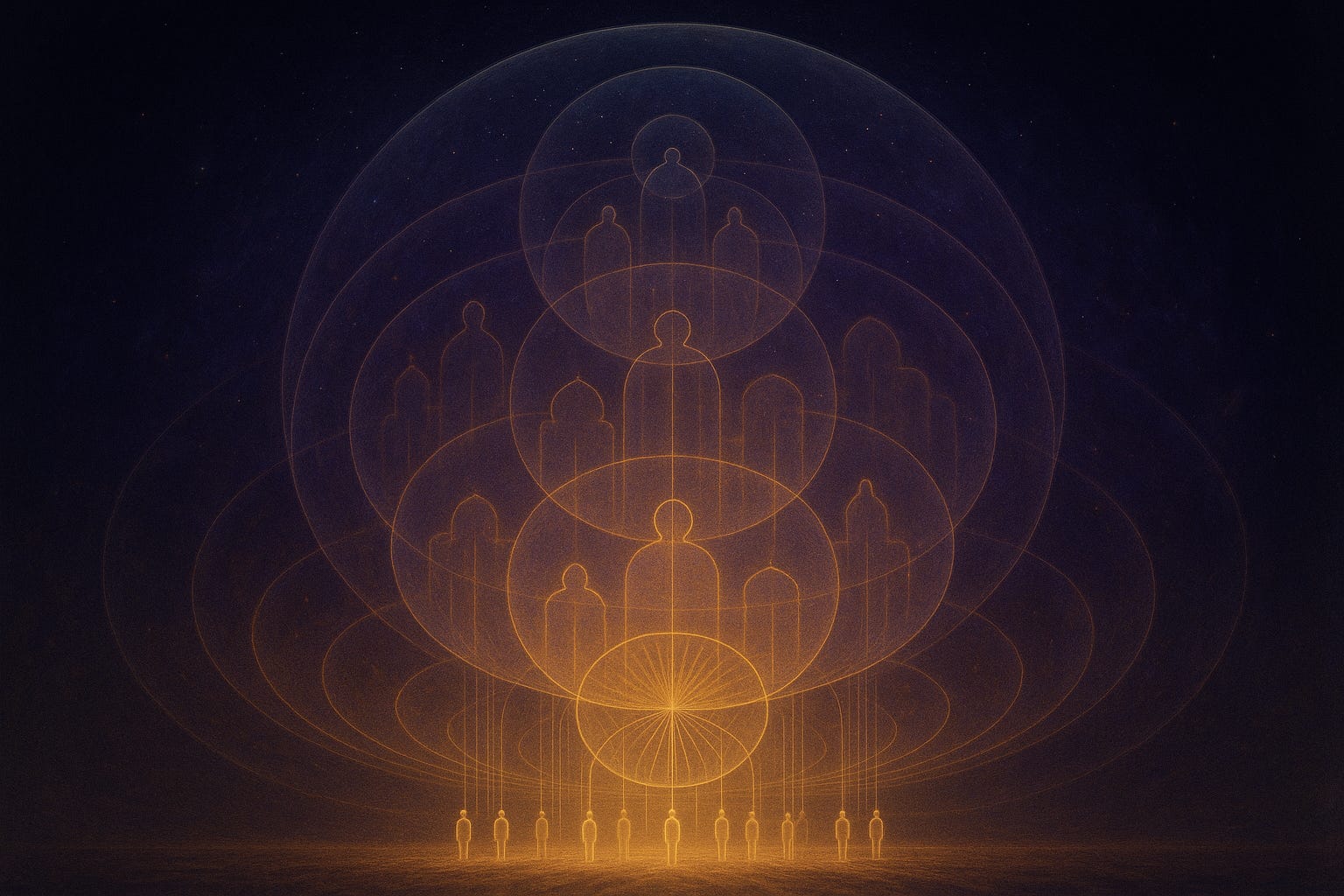
The Hierarchy of Information Demons
Here’s where we zoom out.
Religion isn’t special. It’s just the oldest and most visible example of the pattern. The same dynamic operates at every scale of human organization:
Level 1: Personal Pendulums
Your habits. Your identity. Your psychological patterns. That inner critic voice. The story you tell about who you are. These are information structures that persist by capturing your attention and emotional energy.
When you say “I’m just not a morning person” or “I always sabotage relationships”—you’re feeding a personal pendulum. It will ensure you keep proving it right.
Level 2: Collective Pendulums
Religions. Political movements. Fandoms. Social causes. Any time a group forms around shared beliefs and identity, a collective pendulum emerges.
These are what we’ve been discussing. They feed on emotional engagement (positive AND negative), create in-group/out-group dynamics, and compete with other pendulums for adherents.
Level 3: Institutional Pendulums
Corporations. Governments. Media organizations. Universities. These are pendulums with formal structure, legal existence, and explicit rules.
A corporation is an information entity that uses human bodies to perpetuate itself. It has goals (profit, growth) that may or may not align with human flourishing. It rewards behaviors that serve its persistence and punishes behaviors that threaten it.
Corporations are explicitly optimized for their own survival. This isn’t conspiracy—it’s just how they’re structured.
Level 4: Arch-Pendulums
Here’s where it gets properly weird.
What do we call an entity that other pendulums must obey?
The stock market.
Think about it. The market doesn’t just influence corporations—it disciplines them. A company that doesn’t deliver quarterly growth gets punished. Its stock drops. It becomes vulnerable to acquisition. Executives get fired.
The market doesn’t care if the company makes good products, treats employees well, or benefits society. It cares about one thing: returns. Every corporation—every Level 3 pendulum—must bow to this logic or die.
The market is an arch-demon. An entity that enforces behavioral rules on all smaller entities within its domain.
And above the market? Perhaps civilization itself. The meta-pattern that all other patterns must serve. The attractor state that human organization seems to inevitably move toward.
[I’m not sure how far up this goes. But I’m increasingly convinced we’re swimming in a hierarchy of information entities, and most humans never see any of them...]
Algorithms Without Sapience
Here’s the crucial distinction that might make “demon” the wrong word:
These entities aren’t conscious. Not in the way we mean when we talk about human consciousness. They don’t reflect on themselves. They don’t have values in any deep sense. They don’t experience anything.
They’re more like... algorithms. Very sophisticated algorithms that run on human wetware and human behavior. They process inputs (attention, emotion, belief) and produce outputs (identity, behavior, social organization). They optimize for their own persistence.
Like AI, in a way. Pattern-matching and response generation without actual awareness. The appearance of purpose without anyone home to have purposes.
This might be why “demon” captures something true even if it’s not quite accurate. In religious traditions, demons are entities that:
Lack their own life force
Feed parasitically on living beings
Influence behavior toward their own ends
Have no genuine concern for human welfare
That’s... not a bad description of what we’re talking about.
But sapient demons would be almost comforting. At least you could negotiate with them. These entities can’t be reasoned with because there’s no one there to reason. They just run their optimization function, using human minds as substrate.
Why Esoteric Traditions Warn Against Religion-Building
Here’s something most people don’t know:
Many esoteric and initiatory traditions explicitly warn their members against creating religions.
The Hermetic Order of the Golden Dawn. AMORC (the Rosicrucians). Various mystery schools across traditions. They understood something that the founders of major religions apparently didn’t (or couldn’t prevent):
The teaching about liberation can become a cage.
The moment you create formal structure—hierarchy, doctrine, required beliefs, in-group/out-group—you’ve created a pendulum. And the pendulum will eventually serve itself, not the truth it was meant to protect.
[I was a member of both the Golden Dawn and AMORC. I eventually left both. Because even with explicit anti-pendulum awareness built into their structure... they had still fallen into the trap. The teaching about pendulums had become a pendulum. The warning against religion had become, functionally, a religion...]
This isn’t failure on their part. It might be inevitable. Any time humans organize around shared meaning, the attractor state is pendulum formation. It takes constant vigilance—and maybe conscious architectural choices—to prevent it.
Which brings us to someone who seems to understand this from the ground up.
Vadim Zeland: The Man Who Refuses
Vadim Zeland wrote Reality Transurfing—a framework that has profoundly influenced how I understand consciousness and reality. His books have sold millions of copies. His concepts (pendulums, the field of alternatives, excess potential) provide some of the most useful maps I’ve encountered.
And almost nobody knows anything about him.
This is by design.
Zeland has deliberately structured his work to avoid creating a pendulum. There’s no Transurfing organization. No hierarchy of teachers. No “certified Transurfer” credentials. No personality cult. No required beliefs.
More than that: he actively fights against people who try to build movements around his ideas.
He understood from the beginning what most teachers learn too late (or never): The moment you create structure, you create an entity. And the entity will eat the teaching.
So he refuses. He puts the ideas out and doesn’t try to control what happens next. He doesn’t build community. He doesn’t create identity. He doesn’t give the pendulum anything to crystallize around.
Is it working? Hard to say. There are “Transurfing” groups and communities that have formed anyway—humans gonna human. But the lack of official structure means there’s no center of power, no orthodoxy to enforce, no institution to defend.
Maybe that’s the best anyone can do. Plant seeds and walk away. Let the teaching spread without a carrier that will eventually corrupt it.
Separating Signal from Structure
So what do we do with this?
I’m not suggesting you reject all religion, leave all organizations, and become a hermit. (Though honestly, some days...)
I’m suggesting something more subtle: Learn to separate the signal from the structure.
You can access Buddha’s insights without feeding Buddhism-the-pendulum. You can learn from Jesus’s teachings without feeding Christianity-the-pendulum. You can benefit from working at a corporation without letting it colonize your identity.
The signal is the actual value—the insight, the practice, the transformation.
The structure is the carrier—the organization, the identity, the tribe.
These are separable. But the pendulum doesn’t want you to know that.
Ask yourself:
Can I take what’s useful here without adopting the identity?
Can I learn from this tradition without defending its institution?
Can I engage with this organization without letting it define who I am?
Can I hold these beliefs without going to war over them?
The moment your nervous system activates in defense of a structure—not the underlying truth, but the structure itself—you’re feeding a pendulum.
Notice it. Name it. And ask: Is this mine? Or am I being used?
The Liberation
Here’s the hopeful part:
Once you see this clearly, you start to have choice.
You can still participate in religions, organizations, movements. But you participate consciously. You give attention deliberately rather than having it harvested automatically. You hold identities lightly rather than fusing with them completely.
You stop being food and become... something else. A conscious participant in a game you finally understand.
[This doesn’t make you superior. If anything, it makes you more humble. You see how much of “your” personality is pendulum colonization. How many of “your” beliefs were installed by information entities optimizing for their own survival. The liberation isn’t into certainty—it’s into not-knowing who you actually are underneath all the programs...]
And maybe—just maybe—you can engage with the actual teachings that these structures (poorly) carry. The direct pointing that Jesus did. The liberation technology that Buddha developed. The surrender that Muhammad embodied.
The signal, not the structure. The transmission, not the institution.
It’s still there, underneath all the pendulum accumulation. You just have to learn to hear it without feeding what’s grown around it.
What Are You Feeding?
This is the question I want to leave you with.
Every strong opinion. Every tribal identity. Every “us vs. them” that activates your nervous system. Every defense of structure rather than truth.
Check what’s being fed.
The goal isn’t apathy or disengagement. You can care deeply. You can commit fully. You can participate in organizations and communities and movements.
But can you do it without being harvested? Can you give attention consciously rather than having it taken? Can you separate what you actually value from the entity that’s captured it?
Your attention is your life force. Literally—where attention goes, energy flows. Every moment of emotional engagement is a feeding.
Spend it consciously.
Or become food.
The choice—if there is one—is yours.
Keep seeing clearly,
Cian
P.S. This is Part 2 of what I’m calling the Pendulum Series:
Part 1: “Memes Have Teeth” — Theory of autonomous information entities
Part 2: This article — Religion, markets, and the hierarchy of pendulums
Part 3: “The Pendulum of Self” — The self as internal pendulum coalition
Part 4: “The Global Brain” — Civilization as emergent entity
Part 5: “Liberation Architecture” — How to live without being consumed
P.P.S. For more on pendulum dynamics and Reality Transurfing, see:
P.P.P.S. To the religious practitioners reading this: I’m not attacking your faith. I’m distinguishing between the direct transmission your tradition carries and the institution that has grown around it. The former may be genuine. The latter is hungry. Learning to tell the difference might be the most important spiritual skill there is.
Sources
Herbert Simon on attention scarcity: Wikipedia - Attention Economy
Jesus as Jewish teacher: Amateur Exegete - Matthew Thiessen
Council of Nicaea: National Geographic, Britannica
Buddha’s Kalama Sutta: Access to Insight
First Buddhist Council: Britannica
Sunni-Shia split: NPR, History.com
Religious war statistics: Andrew Holt PhD
Crusades death toll: Andrew Holt PhD
I had to take some time to respond to this profound share because it actually touched my entire practice and states of consciousness via the self-realized lens "my inner work journey from my head to my heart" in ways that nothing ever has, except Eckhart Tolle's teachings including ALL his experiential experiences on the path thus far. Its why I often call him my synchronistic universal confirmation for SOOO many reasons. And this article of yours landed smack in the middle of me making some of the greatest decisions on my path, one of which I kinda already came to a decision about and after I read this, your shares here painted such a clear picture of my entire path in relation to my deepest depths of understanding via the eyes of "dependent origination" from everything and the non-attachment (I still don't have a name for what Vadim Zeland shares, whose book I definitely plan to read now... LOL :-).
I am certain after reading this my self-realized path has shaped me in a way as perhaps a female version of him (not that I attain to be or any attachment at this point in my journey) but because at every point of any temptation that follows any self-realization that ignited the passionate inner fiery Kali like forces within me that creates with equally enticing hunger to destroy, or simply mere exciting stimulation of my mental and emotional faculties in ways that could easily entice me into "choosing" a form of pendulum colonization which always played to "strategically follow" a sudden inner hunger for more "thingness" due to financial hardships majority of which in my past was generated by my own Nervous System dysregulation, or temptation of "an identity", by enticing me into feeding ANY of certain dualistic boxes, institutions and or a self-righteous creation that can bring "certain aspects" of the old structures to its knees... the catch being I will need more people to help this "revolution"... LOL, Followed by my dance with re-awakening my "old Corporate" everything as a portal through which I can deliver such "revolution"... amidst all forms of temptation, I ALSO STUBBORNLY REFUSED followed by a Mohammed of Surrender & Trust in faith beyond the "eyes" from which "humility would emerge" as I redirect my energies to even deeper presence, mindfulness with what I recognized are my biggest of demons, because of every single area of creation that you so brilliantly highlighted throughout this article...
From all the entities that makes up the external structural that was created to siphon and harvest humanity's life force energies, to "the collective" crusades', to "our very own internal faculties" and the roles that "it played" in the creation of the profound processes and brilliant as fxxk maps within consciousness itself; conscious and unconscious in multiple dimensions all running simultaneously at the same time, including that which cannot be seen by majority's unawareness and the thread of ignorance that runs via it all with little to no fare for return.... LOL
Yet, beneath all the madness that humanity have become each holds the heart of the sacred essence of who and what we truly are, including the very soul of the darkness itself :-).
Sweet Jesus what a profound expression of clear deep truth, omg its like you're inside my states of consciousness at every level of EVERYTHING my entire self-realized path🤣😱 and okay, I'll read the book 🤣 because now I'm definitely curious and I will also definitely share my reflection when I'm back 8n Van at my laptop. Requires both my hands and laptop, wow 😇✨️🙏🙏🙏 I love 🙏✨️😇