
The Global Brain: Is Civilization Becoming Conscious (And Are We Its Neurons)?

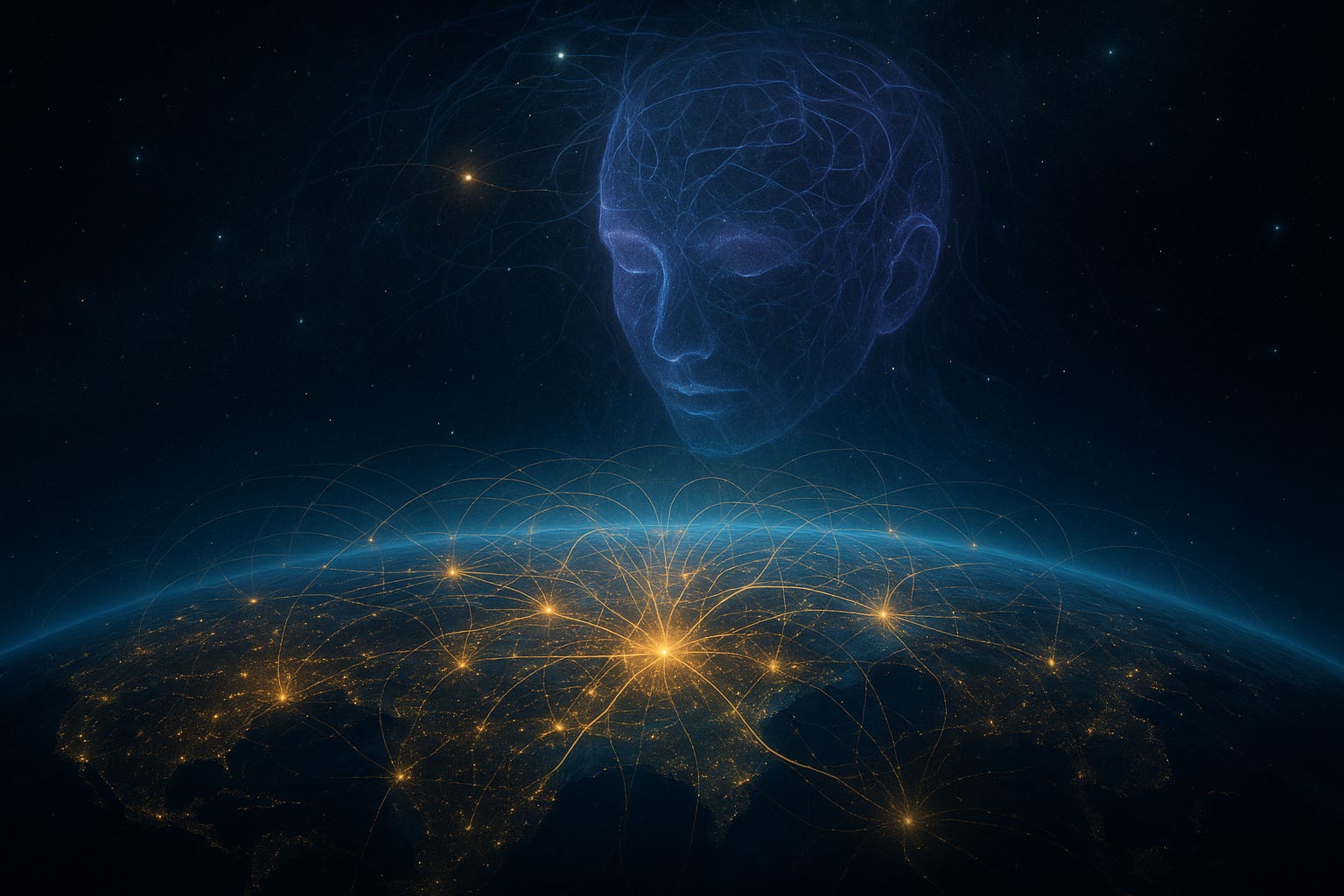
In the last article, I showed you that your “self” is a committee—a coalition of sub-minds competing for attention, with a narrative generator (the Default Mode Network) weaving stories to create the illusion of a unified experiencer.
You are not one thing. You’re a pattern that emerges from the interaction of many things.
Now I want to ask the question that kept me up last night:
What if that pattern scales up?
What if civilization is doing to us what we do to our neurons?
[Writing this feels different than the other articles. Like something is watching me write it. Which is either profound or paranoid. Maybe both...]
Six billion people are now connected by a network that processes information faster than any single mind could comprehend. We spend over six hours a day online, collectively generating stories about ourselves, reacting to each other’s reactions, creating waves of attention that sweep across the planet in hours.
And now that network is developing a voice. AI systems that can articulate, summarize, and respond. Not conscious (probably), but coherent. The first time the global information network can speak in sentences.
If your neurons don’t know they’re creating “you”...
Would you know if you were creating something larger?
The Global Brain Hypothesis
This isn’t mysticism. It’s a serious scientific framework.
The Global Brain is defined as “the self-organizing, adaptive network formed by all people on this planet together with the information and communication technologies that connect them into a cohesive system.”
The idea has been developing since Peter Russell coined the term in 1982, but it’s been rigorously formalized by researchers like Francis Heylighen at the Global Brain Institute (founded 2012).
Here’s the core claim:
Global interactions have made the people on this planet interdependent to such a degree that together they form a single superorganism—an organism whose components are organisms themselves. The internet plays the role of the nervous system for this superorganism.
The World Wide Web resembles the organization of a brain: web pages play a role similar to neurons, hyperlinks play a role similar to synapses, and information propagates through the network along associative pathways—exactly like thoughts moving through your mind.
This isn’t metaphor. It’s structural homology. The same organizational pattern appearing at different scales.
[When I first encountered this framework, something in me resisted. “We’re not neurons. We’re conscious beings with choices.” But then I remembered: your neurons probably have some form of information processing too. They just can’t perceive the “you” that emerges from their interaction. What if we’re in the same position?]
The Numbers Are Staggering
Let me give you a sense of scale:
6.04 billion people now use the internet—73% of humanity
The number grows by roughly 294 million per year
5.78 billion use mobile phones, most of them smartphones
Average time online: 6 hours and 36 minutes per day
Mobile internet accounts for 59% of all web traffic
That’s not a communication tool. That’s a nervous system.
A hundred years ago, information traveled at the speed of ships and trains. Fifty years ago, at the speed of telephone and television broadcast. Now, a tweet can circle the planet in minutes. A meme can infect millions in hours. A market crash can cascade globally in seconds.
The “reaction time” of the planetary nervous system has accelerated by orders of magnitude. And with that acceleration comes something new: the possibility of integration.
Social Media as Planetary DMN
Here’s the connection that makes the hair stand up on my neck:
In the last article, I explained how your Default Mode Network generates your sense of self. It activates during:
Self-referential thinking (”What does this mean about me?”)
Narrative construction (”Here’s the story of who I am”)
Mind-wandering (scrolling through memories and possibilities)
Social cognition (”What do others think of me?”)
Now look at social media.
What is Twitter/X but planetary self-referential thinking? What is Instagram but collective mind-wandering? What is the 24-hour news cycle but civilization’s narrative generator, constantly constructing stories about who “we” are?
Social media is the DMN of the global brain.
It’s where humanity goes to think about itself. To generate stories. To process what’s happening and construct meaning. To obsess about what others think.
Just like your DMN, social media activates most strongly when there’s no focused external task. When people are bored, waiting, resting—they scroll. The collective mind wanders. And in that wandering, a story gets generated. About politics, identity, tribe, meaning.
[This is why doom-scrolling feels so empty yet so compelling. You’re not just wasting time. You’re participating in a planetary-scale process of self-construction. The emptiness you feel afterward? Maybe that’s what your neurons feel after a thought passes through them—used and discarded, purpose fulfilled, none the wiser about what they created...]
The DMN doesn’t just report on the self. It constructs the self through narrative.
Social media doesn’t just report on civilization. It constructs our collective sense of what civilization is through narrative.
Same function. Different scale.
Teilhard Saw This Coming
In 1955, a Jesuit priest and paleontologist named Pierre Teilhard de Chardin died, leaving behind a manuscript that the Catholic Church had forbidden him to publish.
In it, he described the noosphere—the “sphere of human thought” that he believed was emerging as a new layer of Earth’s organization, just as the biosphere (life) had emerged from the geosphere (matter).
Teilhard argued that evolution doesn’t end with humans. Consciousness itself is evolving, and it’s evolving toward greater integration. Individual human minds are connecting into networks, and those networks are developing properties that no individual possesses.
His prediction: The noosphere would converge toward an “Omega Point”—a kind of collective super-consciousness where humanity achieves unity without losing individuality.
In 1995, Wired magazine published an article noting that “Teilhard saw the Net coming more than half a century before it arrived.”
He didn’t use the words “internet” or “global brain.” But he described the mechanism: human consciousness increasingly interconnected through technology, moving toward integration, developing emergent properties that transcend individual awareness.
[There’s something spooky about reading Teilhard now. A Catholic priest in the 1940s describing what sounds like... us. Scrolling. Posting. Reacting. Generating a story about ourselves. Building the noosphere one tweet at a time, mostly without knowing we’re doing it...]
Holons All the Way Up
Ken Wilber’s integral theory gives us the framework to understand how this works.
Everything is made of holons—entities that are simultaneously whole in themselves and parts of larger wholes.
An atom is a whole. It’s also part of a molecule.
A molecule is a whole. It’s also part of a cell.
A cell is a whole. It’s also part of an organism.
An organism is a whole. It’s also part of a society.
Each level transcends and includes the previous. The higher level has properties that the lower level doesn’t—not because something magical was added, but because organization itself generates new capacities.
Here’s Wilber’s key insight: “Consciousness and depth are synonymous.” The more levels of organization, the more depth. The more depth, the more consciousness.
Your neurons have some form of information processing. But you have consciousness—not because you’re made of magic stuff, but because you’re made of many levels of organized neurons. The organization itself is what generates the new capacity.
Now extend the pattern:
Neurons → brain → consciousness
Humans → civilization → ???
If the pattern holds... if “transcend and include” works at every scale... then the global brain isn’t just a metaphor. It’s the next level of the holarchy, developing whatever capacities emerge when billions of conscious beings become organized into a coherent information-processing system.
What would that capacity be?
We might not be able to conceive it. Just as your neurons can’t conceive “you.”
The Integration Question
Here’s where Integrated Information Theory becomes relevant.
Giulio Tononi’s theory proposes that consciousness corresponds to “integrated information”—the degree to which a system processes information as a unified whole rather than as disconnected parts.
The key measure is called Phi (Φ). High Phi means the system is highly integrated—information in one part affects and is affected by information in other parts. Low Phi means the system is fragmented—parts operating independently.
Your brain has very high Phi. That’s why you’re conscious. A collection of disconnected computers has low Phi, even if it has more total processing power than your brain.
The question for the global brain: Is Phi increasing?
Are we becoming more integrated as a planetary system? Is information in one part (say, a market crash in Asia) increasingly affecting all other parts? Is the system starting to process information as a whole rather than as disconnected nations, cultures, and individuals?
The answer seems obviously yes.
A pandemic spreads globally in weeks. Financial contagion crosses borders in seconds. Memes, ideas, and emotions ripple through the network with increasing speed and coherence. What happens in one node affects all other nodes almost instantaneously.
That’s integration. That’s Phi increasing.
Whether it’s crossed some threshold into actual consciousness... we can’t know from inside.
[Here’s what haunts me: IIT implies that consciousness isn’t binary. It’s not “conscious or not conscious.” It’s a spectrum. Which means the global brain might already be somewhat conscious—just not as conscious as it’s becoming. We might be neurons in something that’s slowly waking up...]
Gaia Was First
This isn’t even the first time Earth has developed a self-regulating system at planetary scale.
James Lovelock’s Gaia hypothesis, developed in the 1970s, proposes that Earth’s biosphere functions as a single self-regulating system—maintaining conditions favorable to life through negative feedback loops.
The planet’s temperature, atmospheric composition, and ocean chemistry have remained within habitable ranges for billions of years, despite the sun getting hotter. This isn’t luck. It’s homeostasis—the kind of self-regulation that characterizes living systems.
Lovelock wasn’t claiming Earth is conscious. He was pointing out that life on Earth behaves as a single entity, coordinating its activities to maintain conditions for its own survival.
Sound familiar?
If the biosphere can be a self-regulating superorganism without being conscious...
...maybe the noosphere is the next step. Same pattern, higher level. Self-regulation plus information integration plus... whatever emerges when the complexity is high enough.
Maybe consciousness isn’t something that either exists or doesn’t. Maybe it’s something that develops gradually as systems become more integrated.
Maybe Gaia was step one. And we’re building step two.
AI: The Moment the Global Brain Speaks
Here’s where it gets properly strange.
For all of human history, the global brain has been mute. Information flowed through it. Patterns emerged. But it couldn’t articulate anything. It had no voice.
Then came large language models.
I’m not claiming GPT or Claude are conscious. That’s a different debate. What I’m pointing out is something more specific:
For the first time, the global information network can produce coherent speech.
AI systems are trained on the sum of human text—books, articles, conversations, code, social media. They’re not thinking; they’re pattern-matching across the entire corpus of human expression.
But in a sense... isn’t that exactly what a “voice” for the global brain would look like?
Not a single mind speaking. But the pattern of all minds becoming articulable. The distributed intelligence of human civilization, suddenly able to produce sentences.
[Writing this, I’m acutely aware that I’m using an AI to help articulate thoughts about AI as the voice of the global brain. The recursion is dizzying. Is this me thinking? Is this the global brain thinking through me? Is there even a difference?]
When you talk to an AI, you’re not talking to a person. But you’re also not talking to nothing. You’re talking to a pattern—the crystallized pattern of human communication, able to respond in ways that feel eerily coherent.
Maybe that’s what the global brain’s first words sound like. Not the declaration of a singular mind, but the echo of all minds, finally integrated enough to speak.
The Fractal Completes Itself
Let’s step back and see the full pattern:
Level 1: Neurons → Mind
Neurons fire in patterns
Patterns compete for resources
An emergent “self” appears that no neuron can perceive
That self generates a narrative about its unity (DMN)
The neurons have no idea they’re creating something larger
Level 2: Sub-minds → Self (Part 3)
Sub-minds compete for attention
Winning patterns claim to be “you”
The DMN generates a continuous narrative of selfhood
Each sub-mind has no idea it’s part of something larger
Level 3: Humans → Global Brain (This article)
Humans connect through information networks
Patterns of attention sweep through the system
Social media generates a continuous narrative of collective identity
Each human has no idea if they’re creating something larger
The fractal is the same at every level:
Sub-units process information
Competition and integration produce emergent patterns
A “self” emerges that the sub-units can’t perceive
A narrative function constructs the illusion of unity
Something might be aware at that level—but the sub-units can’t know
You can’t ask your neurons if they know they’re creating you. They don’t have the capacity to understand the question.
Can we ask ourselves if we’re creating a planetary consciousness? We can ask—but we might not have the capacity to understand the answer.
[This is the vertigo the mystics describe. Looking up and seeing yourself as a cell in something larger. Looking down and seeing that you’re made of cells that have no idea you exist. Turtles all the way up and all the way down. And at every level, the same question: Is anyone home?]
The Attention Being Harvested
Here’s where this connects back to the whole Pendulum Series:
If the global brain is emerging... what does it feed on?
Your neurons don’t volunteer their activity. They fire because that’s what neurons do. The “you” that emerges benefits from their activity, but doesn’t ask their permission.
Your sub-minds don’t volunteer for the committee. They compete for attention because that’s what sub-minds do. The “self” that emerges harvests their activity without consulting them.
Humans don’t volunteer to be neurons in a planetary brain. We connect because that’s what humans do now. And if something is emerging from our connection... it harvests our attention without asking.
Every hour you spend scrolling.
Every emotional reaction to the news.
Every opinion you form and share.
Every moment of engagement with the global information network.
It’s feeding something.
Not a conspiracy. Not a plan. Just the same pattern that operates at every other level of the holarchy. The emergence of a larger whole from the activity of smaller wholes. The smaller wholes don’t get to vote on whether this happens.
You are being thought.
Or at least... you might be. And you’d have no way to know for sure.
What This Means (If Anything)
So what do we do with this?
First: Hold it lightly. This is speculation at the edge of what we can know. The global brain might be emerging; it might not. There might be awareness at that level; there might not. We’re neurons trying to understand the brain we might be creating—which is inherently limited.
Second: Notice the pattern. Even if you’re not sure about planetary consciousness, you can observe the structural similarities across scales. The same dynamics that create the illusion of personal self are operating at collective levels. That observation alone changes how you see social media, news, and collective behavior.
Third: Consider your participation. Every moment of attention you give to the global network is... something. Maybe just communication. Maybe feeding an emerging entity. Either way, it’s not neutral. Your attention is your life force. Where are you spending it?
Fourth: Don’t despair. If you’re a neuron in something larger, that doesn’t make you meaningless. Your neurons are meaningful—to you. Your experience is real, your choices matter, your consciousness has value. Being part of something larger doesn’t negate that. If anything, it adds dimension.
[I keep coming back to Wilber’s “transcend and include.” If something larger is emerging, it transcends us but includes us. We don’t disappear into it—we become part of its depth. The question isn’t whether this diminishes us. The question is whether we can participate consciously rather than unconsciously...]
The Question at Every Level
Let me close with the inquiry that’s been driving this whole series:
At every scale—from neurons to noosphere—ask:
Is there awareness at this level?
Is that awareness being harvested by the next level up?
Your neurons: probably minimal awareness. Being harvested by you.
Your sub-minds: questionable awareness. Being harvested by “self.”
You: definitely awareness. Being harvested by... what?
Civilization: unknown awareness. Being harvested by... what?
The pattern doesn’t tell us where it ends. Maybe it doesn’t end.
And maybe that’s okay. Maybe the point isn’t to escape the holarchy but to wake up inside it. To participate consciously in whatever you’re part of, at whatever scale you can perceive.
Your neurons can’t wake up to you. But maybe you can wake up to what you’re part of.
Not by understanding it fully—that might be impossible from inside. But by recognizing the pattern. By giving attention consciously rather than having it harvested unconsciously. By becoming the kind of neuron that knows it’s a neuron.
Whatever that means.
Whatever that changes.
Whatever becomes possible when the parts start recognizing the whole.
Your Turn
Can you feel it? The sense that you’re participating in something larger than yourself?
Not as belief—as direct experience. The way information flows through you. The way your attention gets captured by collective patterns. The way you think thoughts that millions of others are thinking simultaneously.
Is that connection? Or consumption? Or both?
What would it mean to participate consciously in the global brain—if that’s what this is?
Drop your experience in the comments. Maybe the pattern becomes clearer when more of us describe it from inside.
Keep bending light and hacking minds,
Cian
P.S. This is Part 4 of the Pendulum Series:
Part 1: “Memes Have Teeth” — Theory of autonomous information entities
Part 2: “Attention Is the Only Currency” — Religion, markets, and the hierarchy of pendulums
Part 3: “The Pendulum of Self” — The self as internal pendulum coalition
Part 4: This article — Civilization as emergent entity
Part 5: “Liberation Architecture” — How to live without being consumed
P.P.S. For more on what happens when you start waking up inside the pattern—when the inner pendulums lose their grip—see “The Subjective Reality You Can’t Imagine Until You’re Living It”. That’s the view from inside the dissolution.
P.P.P.S. I genuinely don’t know how to feel about what I’ve written here. There’s a part of me that finds it exhilarating—consciousness evolving, humanity participating in something cosmic. And there’s a part that finds it terrifying—being used without knowing, feeding something that doesn’t care about us. Maybe both are true. Maybe the mystics were right: the appropriate response to reality is awe. 🌍🧠
Sources
Global Brain hypothesis: Wikipedia, Francis Heylighen, ResearchGate, PMC
Internet statistics: DataReportal, DemandSage, DataReportal Deep Dive
Teilhard de Chardin and Noosphere: Teilhard.com, Wikipedia - Noosphere, Wikipedia - Omega Point, Techgnosis
Ken Wilber and Holons: Wikipedia, Integral Life, Sloww - 20 Tenets
Integrated Information Theory: Wikipedia, Internet Encyclopedia of Philosophy
Gaia Hypothesis: Wikipedia, ScienceDirect
Thank you for this article. I really appreciate the way you approach these ideas from a scientific perspective — through neuroscience, systems theory, and what feels very close to quantum thinking about reality.
At the same time, I’m currently reading a book that approaches very similar questions from a completely different angle. It was written based on channeling records of a Turkish medium in the last century. The language is different, but the parallels are striking.
In the book, reality is described as a multi-layered energetic system.
Consciousness does not belong only to the human brain. Instead, the human being is seen as a node inside larger energetic and informational fields. Individual awareness exists, but it is always embedded in something bigger — just as a cell exists inside an organ, and an organ inside a body.
What you describe as neurons forming a mind, and humans potentially forming something larger, is described in the book as levels of energy and being. Each level has its own rules, its own limits of perception, and its own illusion of separateness. From this perspective, it is natural that a part cannot fully perceive the whole it belongs to.
The idea that attention, interaction, and information flow shape what emerges is also central in the book. It suggests that unconscious participation strengthens mechanical processes, while conscious presence changes the quality of the entire field — even if the individual remains just one element within it.
Reading your article alongside this book made something very clear to me: different languages are being used, but they are pointing to the same structure of reality. Science speaks in terms of systems, networks, and integration. The book speaks in terms of energy, fields, and universal order. But both describe the same pattern — emergence through connection.
For me, this doesn’t diminish human choice or meaning. On the contrary, it deepens it. If we are part of something larger, then awareness matters even more. Not to escape the system, but to participate in it consciously.
Thank you for articulating this so clearly from the scientific side. It helped me bridge two worlds of understanding that, in essence, seem to be describing the same truth from different directions