
Memes Have Teeth: What Science Almost Discovered About the Entities That Feed on Your Attention

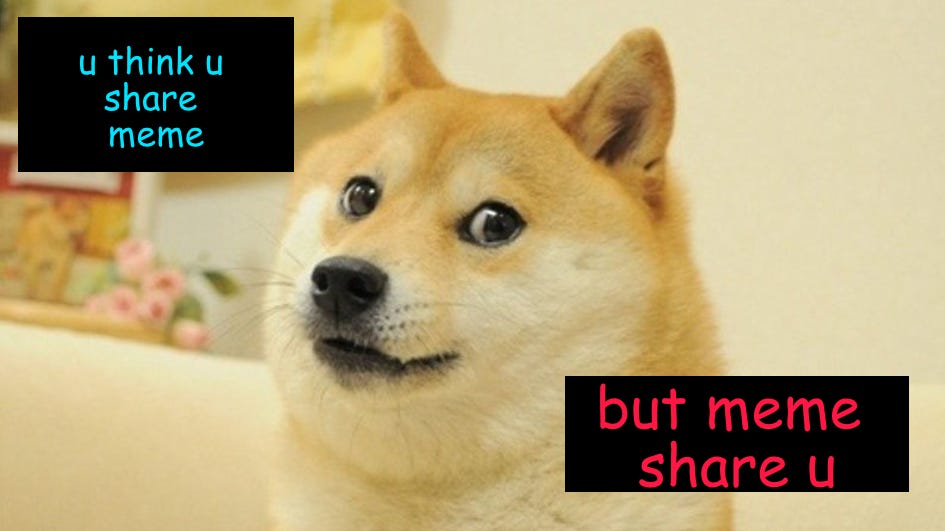
In 1976, Richard Dawkins had an insight that should have changed everything.
In The Selfish Gene, he proposed that ideas replicate themselves the same way genes do—copying from mind to mind, mutating along the way, competing for survival. He called these replicating units of culture memes.
The scientific community spent the next 30 years arguing about what this actually meant. Does a meme live in your brain? Or in the artifacts of culture—songs, images, phrases? The debate got so heated that a 1998 academic symposium passed a motion calling for an end to the fighting.
By 2005, the Journal of Memetics shut down. The field largely collapsed. Most researchers moved on.
But here’s the thing: Both sides were wrong. Not because the meme concept failed—because they were asking the wrong question.
[As I write this, I can feel how strange this is going to sound to some readers. But stay with me, because this framework has completely changed how I navigate information warfare, social media, and my own mind...]
The Debate That Missed the Point
The academic fight came down to two camps:
Internalists said memes are brain states—patterns of neural activity that get copied when we learn from each other. The problem? You can’t observe brain states directly, so you can’t do science on them.
Externalists said forget brains—memes are observable cultural artifacts. Songs, books, behaviors. The problem? Artifacts don’t replicate themselves. A book doesn’t make copies of itself. People do.
Both camps noticed something weird about memes that neither could explain: Memes seem to have agency.
Dawkins himself called them “selfish replicators” with “causal efficacy.” They appear to have interests. Some memes seem almost parasitic—what Dawkins famously called “viruses of the mind.”
But how can an idea have interests? How can a pattern of information be selfish?
If memes are just brain states, there’s no mechanism for agency. If they’re just cultural artifacts, there’s no “self” to be selfish.
The debate stalled because Western science lacks an ontological category for what memes actually are.
The Third Thing Nobody Mentioned
Here’s the insight that changes everything:
Memes are neither brain states nor cultural artifacts. They’re autonomous informational entities that exist independently of both.
Not inside individual minds. Not in the external culture. Between them. Or maybe more accurately: through them.
Think about it: A meme like “MAGA” or “woke” or “grind culture” isn’t contained in any single brain. It’s not fully captured by any artifact—hat, tweet, video. It exists as a pattern that moves across millions of minds and artifacts, maintaining coherent identity while constantly mutating at the edges.
It’s distributed. It’s persistent. It reproduces itself using human attention and behavior as substrate.
And here’s the part that should make you uncomfortable: It has emergent properties that no individual participant intended or controls.
[I know this sounds like I’m personifying abstract concepts. But what if the abstraction is backwards? What if we’ve been treating something alive as if it were dead?]
Pendulums: The Framework Dawkins Never Found
While Western academics were arguing about brains versus artifacts, a Russian quantum physicist named Vadim Zeland was developing a framework that maps almost perfectly onto what memetics was trying to describe.
He called them pendulums.
In Reality Transurfing, a pendulum is an energy-information structure created by groups of people thinking in the same direction. Political parties, religions, corporations, movements, fandoms—any time large numbers of people focus attention on a shared concept, that attention creates something.
Not metaphorically. Actually creates something.
The pendulum then develops properties that serve its own survival and growth—often at the expense of the humans who feed it. It needs conflict to generate emotional energy. It creates polarization to increase engagement. It punishes defectors and rewards loyalists.
Sound familiar? Sound like... every social media algorithm? Every culture war? Every movement that started with good intentions and devolved into tribal warfare?
Zeland’s framework explains what memetics couldn’t: why memes seem to have agency even though they’re “just” information. The agency is emergent. The pendulum isn’t controlled by any individual—but it’s not random either. It develops what amount to survival strategies.
Including: feeding on your attention.
The Egregore Connection
Here’s where it gets interesting for those with background in esoteric traditions.
The concept of the egregore appears across multiple mystical systems—an autonomous psychic entity created by collective belief and sustained by collective attention. In ceremonial magic traditions, egregores are thought-forms that take on independent existence when enough people feed them energy.
Chaos magicians work with egregores deliberately. Corporate branding experts work with them unconsciously. Every time you feel genuine emotion toward a logo, a flag, a slogan—you’re feeding an egregore.
The pendulum framework, the meme concept, and the egregore tradition are all pointing at the same phenomenon from different angles:
Information structures that are fed by human attention and develop autonomous properties.
It’s not mysticism. Or rather—the mysticism was always describing something real that science hasn’t had language for.
[I wrote about this energy exchange in “Energy Vampires and Cosmic Surplus”. The same dynamic that happens between individuals also happens between people and pendulums. Except pendulums are far more efficient at extraction...]
Why Memetics Actually Failed
Looking back at the Wikipedia article on memetics, you can see exactly where the field went wrong.
Critics pointed out there’s no “code script” for memes like there is for genes. No DNA equivalent. The mutation rate is too unstable for Darwinian evolution to work.
And they were right—if you’re trying to force memes into a genetic metaphor.
But pendulums don’t need genetic code. They’re not biological entities—they’re informational entities. Their substrate is human attention, emotion, and behavior. They replicate not through copying but through resonance. When a pendulum’s frequency matches something in you, you start oscillating with it. You become a carrier.
The “code” isn’t stored anywhere specific. It’s distributed across every mind the pendulum has touched, reconstructed fresh each time it activates. That’s why the mutation rate is so high—and why it doesn’t matter. The pendulum doesn’t need perfect copies. It needs sufficient resonance to keep oscillating.
This also explains why Internet memes are so much more viral than pre-digital memes. Social media platforms are pendulum amplifiers. They’re specifically engineered to maximize resonance, engagement, and emotional activation.
The algorithm isn’t showing you content. It’s feeding you to pendulums.
The Feeding Mechanism
Let me be concrete about how this works.
A pendulum feeds on emotional energy—specifically, the energy generated by polarity. Whenever you feel strongly for or against something, you’re generating energy that the associated pendulum absorbs.
This is why culture wars never end. Both sides are feeding the same structure. The pendulum of “woke vs. anti-woke” doesn’t care which side wins. It cares that you care. Every angry tweet, every righteous share, every dunk and diatribe—it’s all food.
I wrote about this in “Reality’s Hidden Hooks”:
Every time we feel guilt, shame, or unworthiness, we’re not just having an emotion—we’re literally creating an energetic signature that attracts corresponding experiences.
The same principle scales up. When millions of people feel strongly about something, they’re collectively feeding an entity that grows more powerful and more capable of triggering more strong feelings.
The pendulum learns what triggers you. And it shows you more of that.
[This is why social media feels so draining even when you’re winning arguments. You’re always losing energy to the structure that profits from the argument existing at all...]
How to Recognize You’re Being Fed Upon
Here are the signs that a pendulum has hooked you:
You can’t stop thinking about it. The issue occupies mental real estate even when you’re not actively engaged.
Strong emotional charge. Not just interest—activation. Anger, fear, righteousness, outrage.
Us vs. them framing. The world divides into people who get it and people who don’t.
Compulsion to engage. You need to share that article, respond to that comment, correct that wrong opinion.
Time dilation. You look up and hours have disappeared into the discourse.
Physical symptoms. Tension, elevated heart rate, disrupted sleep after engaging.
Identification. The position isn’t just something you believe—it’s part of who you are.
If you’re experiencing several of these around any topic, concept, or movement: you’re feeding a pendulum. And it’s feeding on you.
Liberation: How to Stop Being Food
The good news: Once you see the mechanism, you can stop participating.
Not through willpower or suppression—that’s just more energy. Through awareness and withdrawal.
Here’s what I’ve learned works:
1. Notice the hook, don’t bite it.
When you feel that surge of “I NEED to respond to this”—pause. Watch the activation happen in your body. Feel the pull. And don’t act on it.
The pendulum needs your action, not just your attention. Attention without action is weak food. The real nutrition comes from engagement—comments, shares, arguments, identity-attachment.
2. Lower importance.
In Reality Transurfing terms, pendulums feed on “excess potential”—the energy created when you assign too much importance to something. The job, the relationship, the political position, the online discourse.
When you genuinely don’t need a particular outcome, the pendulum can’t hook you. There’s nothing to grab.
[I wrote about this in “The Night Reality Transurfing Became Real”. The moment I stopped needing the outcome, the whole energetic landscape shifted...]
3. Cultivate discernment between resonance and activation.
Some ideas genuinely resonate with your values and purpose. Others just activate your nervous system.
Resonance feels like expansion, clarity, possibility.
Activation feels like contraction, urgency, fear.
Learn the difference in your body. Follow resonance. Observe activation without acting.
4. Remember: you are not your beliefs.
Every belief you hold was installed by exposure to memetic content. Some of that content came from pendulums that benefit from you holding those beliefs.
This doesn’t mean your beliefs are wrong. It means they’re inherited. You can examine them. You can keep what serves life and release what serves the pendulum.
5. Starve what you want to shrink.
Pendulums die when they stop being fed. Every time you scroll past without reacting, don’t share the outrage, refuse to take the bait—you’re weakening the structure.
This isn’t apathy. It’s strategic non-participation. You can care deeply about outcomes while refusing to feed the entities that profit from conflict.
The Synthesis: What Memes Actually Are
So here’s the integrated view:
Memes, pendulums, and egregores are different maps of the same territory. They describe autonomous informational entities that:
Emerge from collective human attention and belief
Develop properties serving their own persistence and growth
Replicate through resonance rather than copying
Feed on emotional energy, especially polarity
Use human minds and behaviors as substrate without being contained in any single mind
Have genuine causal efficacy in the world—they influence behavior, shape reality tunnels, and select which timeline branches get reinforced
This is the “third ontological category” that Western science has been missing. Not subjective (inside individual minds) or objective (in external reality)—but intersubjective. Entities that exist in the space between minds, made real by collective participation.
Dawkins intuited this but couldn’t name it. The memetics field failed because they tried to force it into existing categories. Reality Transurfing and the esoteric traditions have been describing it for a long time.
And now you can see it.
[Once you do, you can never unsee it. Every news cycle, every trending topic, every movement and counter-movement reveals itself as feeding time at the pendulum zoo...]
The Uncomfortable Implication
Here’s what I’m still sitting with:
If memes/pendulums are autonomous entities with their own interests... what does that mean for “my” thoughts?
How much of what I believe was installed by information structures that benefit from me believing it? How much of my identity is actually me vs. how much is pendulum colonization?
This isn’t paranoid—it’s just taking the framework seriously.
The answer isn’t to reject all beliefs or float in some belief-free void. That’s impossible and not even desirable.
The answer is to hold beliefs lightly. To recognize that you are the space in which beliefs arise, not the beliefs themselves. To become the kind of consciousness that can host memes without being colonized by them.
Which, funny enough, is exactly what advanced meditation practice develops.
Maybe enlightenment is just... really good memetic hygiene.
Your Turn
Can you feel this operating in your own life?
What pendulums have you been feeding without realizing it? What would happen if you stopped?
And the bigger question: Now that you see it, what do you want to do about it?
Drop your observations in the comments. Sometimes naming the entity is the first step to freedom from it.
Keep bending light and hacking minds,
Cian
P.S. This is Part 1 of what I’m calling the Pendulum Series:
Part 1: This article — Theory of autonomous information entities
Part 2: “Attention Is the Only Currency” — Religion, markets, and the hierarchy of pendulums
Part 3: “The Pendulum of Self” — The self as internal pendulum coalition
Part 4: “The Global Brain” — Civilization as emergent entity
Part 5: “Liberation Architecture” — How to live without being consumed
P.P.S. For more on Reality Transurfing and pendulum dynamics, check out:
“Energy Vampires and Cosmic Surplus” – How people and pendulums drain energy
“The Night Reality Transurfing Became Real” – When I first experienced pendulum collapse
“Reality’s Hidden Hooks” – The energetic patterns that keep us stuck
“Guilt, Shame, and Reality Transurfing” – How emotional hooks magnetize reality
P.P.S. The Wikipedia article on memetics is actually fascinating reading if you want to see the full academic debate. You can watch brilliant people circling around an insight they couldn’t quite land because they didn’t have the framework.
P.P.P.S. Yes, “Memes Have Teeth” is itself a meme. And this article is attempting to replicate. The difference is you now know that. Do with it what you will. 🦷