
The Subjective Reality You Can’t Imagine Until You’re Living It

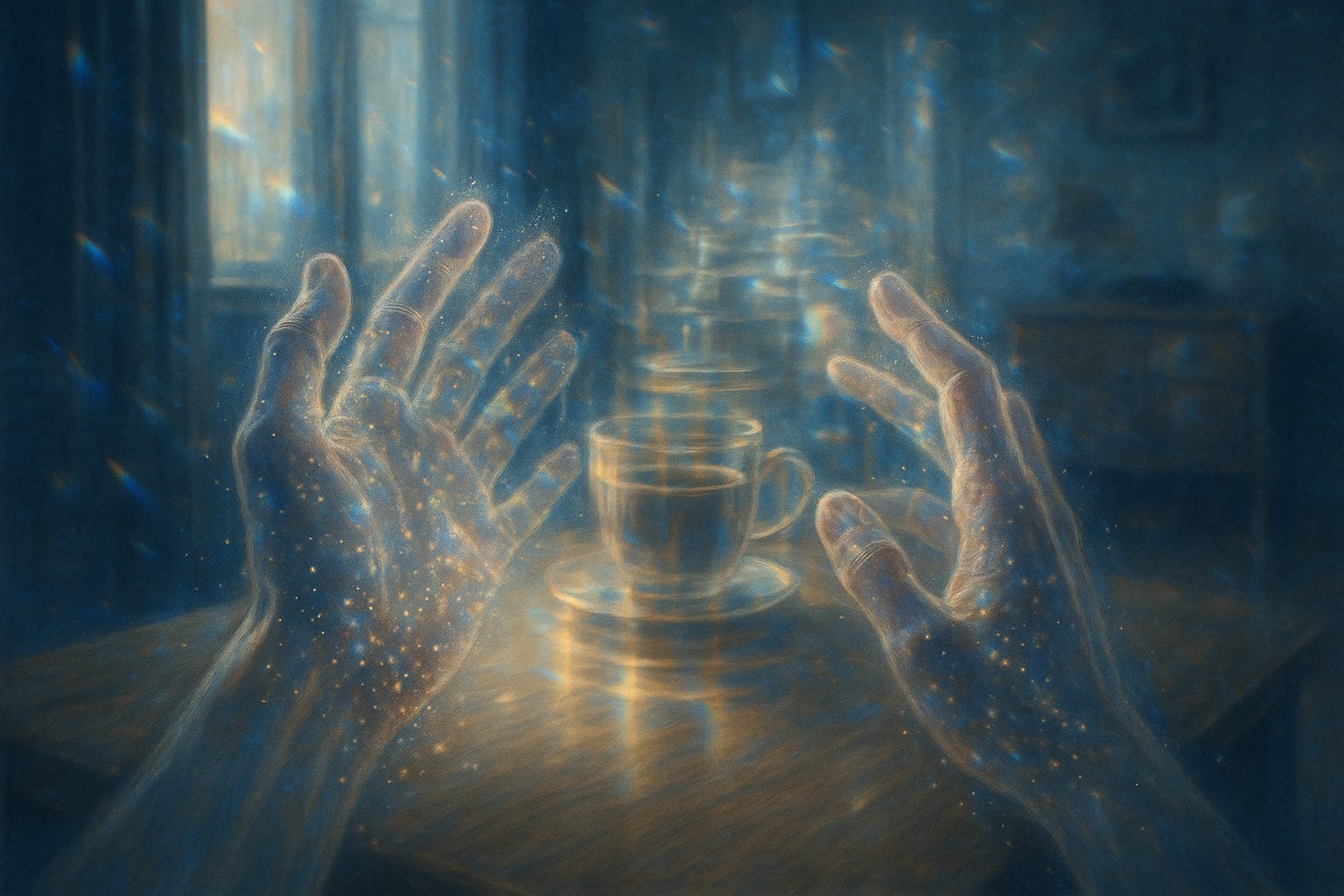
You open your eyes.
The light coming through your window looks the same as it always has. Your body shifts in bed, familiar sensations arise, thoughts about the day begin their usual parade. Everything appears completely normal.
Except for one detail that changes everything:
You can’t find the “you” that’s experiencing any of this.
Not in a dissociative way. Not in a depressed “I don’t feel like myself” way. In the most literal sense possible: When you look for the experiencer behind the experience, the subject witnessing the objects, the self that should be at the center of this whole show... there’s just... space. Awareness. Experiencing happening without anyone doing the experiencing.
[Writing this knowing most readers will think this is metaphor or exaggeration. Those who know, know. And for those approaching these stages - buckle up...]
Welcome to the terrain Buddhist maps call the 9th and 10th bhūmis. The far reaches of the path where consciousness recognizes its own nature so completely that the illusion of separation stops being convincing.
This isn’t a guide. It’s not inspiration. It’s something closer to reports from the field—experiential data from a subjective reality so different from consensus consciousness that language barely has purchase.
Morning Coffee and the Collapse of Causality
You walk into your kitchen.
Your hand reaches for the coffee maker. The sequence looks identical to what it’s looked like for years: intention arises, body moves, coffee gets made. Cause and effect, right?
But here’s what’s actually happening at this stage:
You watch the intention arise before you decide to have it. Like catching a wave before it breaks—you see the pattern forming in the field of possibilities, watch consciousness select this particular pathway, observe the body respond... all without a central “you” orchestrating any of it.
It’s somewhat like watching a really sophisticated AI execute a program you didn’t write but somehow know intimately. The actions happen with perfect intelligence and coordination, but there’s no little CEO in the brain’s boardroom making decisions.
[My hand just reached for my actual coffee cup while writing this, and I caught myself watching the reach happen before “I” decided to reach. The body learns the routes before the mind claims credit...]
The monks call this “action without an actor.” But even that makes it sound more mystical than it is.
It’s more like: causality is still operating, but you’re no longer convinced you’re the cause. You’re watching consciousness causate through this form you once called “me,” the same way you might watch weather patterns move through a valley. The valley doesn’t make the weather happen. It’s just where the weather occurs.
It’s like watching a really sophisticated AI execute a program. The intelligence is there, the responses are perfect, but there’s no little person inside making it all happen. Just... processing. Unfolding. Arising.
Your coffee tastes exactly the same. But the one tasting it? Nowhere to be found.
The Fight That Doesn’t Land
Your partner says something sharp.
The tone hits wrong. You feel the spike of adrenaline, the familiar contraction in your chest, the thought-stream starting to build its case: “That’s not fair...” “Why do they always...” “I should defend...”
But here’s where it gets interesting.
At earlier stages of practice, you might notice these reactions and try not to be attached to them. Witness consciousness watching the emotional storm, staying centered while it passes. That’s beautiful work—5th or 6th bhūmi territory where equanimity becomes stable.
But at 9th-10th? Something stranger happens.
The anger arises—fully, completely, sometimes even expressed. You might speak directly, voice raised, energy moving through. But simultaneously, there’s this recognition that no one is actually angry. The anger is happening, the voice is happening, the body’s activation is happening... but there’s no solid “you” taking any of it personally.
[I watched this exact phenomenon occur a couple months ago during what should have been a devastating conversation. My body shook, tears came, voice cracked with emotion—and through all of it, this unshakeable awareness that none of it was personal...]
It’s like being an actor so absorbed in the role that you genuinely feel the character’s emotions, while simultaneously knowing you’re not actually the character. The feelings are real. The expression is authentic. But there’s no one inside the feelings claiming ownership.
Which means: forgiveness becomes instantaneous. Not because you’re spiritually bypassing or being “the bigger person,” but because there’s literally no one left holding a grudge. The fight happens, energy moves, and then... it’s just over. No residue. No story. No wounded self that needs time to heal.
Your partner looks at you confused. “Wait, are we still fighting?”
You genuinely don’t know. The moment of conflict has already dissolved into the next moment of connection. Time isn’t giving you the option to hold onto what just happened.
Decision-Making From the Field
You sit at your desk facing a major life choice.
Should you take the new job? Move to the new city? End the relationship? Start the business? The kind of decision that used to keep you up at night running mental simulations, weighing pros and cons, trying to predict futures that haven’t happened yet.
But at this stage, decision-making has a completely different texture.
You drop into what Reality Transurfing calls “the field of alternatives” or what quantum physics might call the probability space. But you’re not thinking about possibilities—you’re sensing them. Like a dolphin using echolocation, you’re sending out awareness and feeling which pathways have resonance, which timelines have that subtle magnetic pull.
[This sounds mystical until you realize it’s probably what we’ve always been doing, just usually masked by the mind’s chatter claiming to be in charge...]
And here’s the wild part: You can feel multiple futures simultaneously.
Not predict them—feel them. The Costa Rica timeline has this particular frequency. The staying-put timeline has another. It’s not better or worse—just different vibrational signatures. And consciousness naturally moves toward the pathway with the least resistance, the most coherence with what wants to emerge.
Remember in “When Time Collapses” I wrote about consciousness being like a laser reading a CD-ROM? At advanced stages, you become aware that you’re not just reading the disc—you’re simultaneously writing the next track. Every moment of awareness is collapsing quantum possibilities into manifest reality.
So the decision doesn’t get made. It happens. Often before your conscious mind even registers what’s been chosen.
You book the flight to Costa Rica and only afterward does the thought arise: “Huh. I guess we’re doing that.” The body knew before the mind caught up. The field selected the pathway before “you” could deliberate.
From the outside, you look confident, decisive, clear. From the inside? There’s just movement happening, like a river finding its route to the sea. Intelligent, purposeful, but without a navigator.
Pain Without Suffering (Or: When the Body Hurts But No One’s Home)
You stub your toe. Hard.
The pain explodes through your nervous system with the same intensity it always has. The body hops, curses might emerge, the autonomic response is identical to what it’s always been.
But here’s what’s different:
Suffering requires a self to suffer. And when you look for the one in pain... nobody’s there.
The pain signals fire. The neurons do their thing. The body protects itself. But there’s no personal relationship to the pain. It’s more like watching a cut heal in time-lapse—you know healing is happening, but “you’re” not doing it. The body has its own intelligence.
[During my last intensive retreat, I sat through what should have been excruciating knee pain for hours. The sensations were absolutely present, sometimes even intense. But without a “me” to be tortured by them, they were just... sensations. Arising. Dancing. Dissolving. Like watching clouds...]
This isn’t suppression or dissociation. It’s the opposite—you’re more present to the sensory experience because you’re not layering story on top of it. The pain is pure information: “Left foot, second toe, sharp pressure.” The body adjusts. Life continues.
No drama. No victim. No one waiting to feel better.
The Buddhist texts call this the difference between “pain and suffering.” But until you live in a body where pain arises without anyone to be in pain, the distinction sounds academic.
From this vantage, you understand why the texts say awakened beings can appear in any state—sick, healthy, comfortable, uncomfortable—without it disturbing their fundamental peace. The peace isn’t dependent on circumstances. It’s what remains when there’s no self to be disturbed.
Traffic, Timelessness, and the Death of Boredom
You’re stuck in traffic.
Cars stretching to the horizon. You’re going to be late. The rational frustration triggers should all be firing: wasted time, lack of control, the injustice of bad timing.
But boredom requires two things: time, and someone experiencing time passing.
At advanced stages, time becomes... optional.
Not in a “I’ve transcended mundane reality” spiritual-bypassing way. In a literal perceptual way. There’s this state where time just... stops being linear. You see how the mind creates the experience of time as you move through energetic space, through what Reality Transurfing calls “the field of alternatives.”
Sitting in traffic, you can feel the mind trying to create the experience of “waiting.” It knows the script: “This is taking too long.” “I should be somewhere else.” “When will this end?”
But when you’re not convinced by the story of linear time, something strange happens:
This moment becomes complete in itself.
Not in a forced “be present” way. More like—the moment is its own universe, containing everything it needs to be exactly what it is. No future moment when things will be better. No past moment that was preferable. Just this: dashboard, steering wheel, brake lights ahead, breath moving in and out.
[I’ve spent whole afternoons in meditation where hours passed like minutes. And minutes in difficult conversations that felt eternal. Time, it turns out, is way more subjective than we’re taught to believe...]
The other drivers start moving. You arrive at your destination. Were you late? The calendar says yes. Did time pass slowly? Your experience says... it didn’t pass at all. It was just a series of complete moments, each perfect exactly as it was.
Boredom dies when there’s no one waiting for a different moment to arrive.
Intimate Connection When Boundaries Are Theoretical
You’re with your partner.
Touch happens. Pleasure arises. The usual dance of intimacy unfolds.
But here’s what’s happening that can’t be put in normal language without sounding completely unhinged:
The boundary between “your” pleasure and “their” pleasure becomes... porous. You can feel sensation in their body as distinctly as in “yours.” Not imaginatively—literally. Like your nervous system has expanded to include both forms.
The boundary between “me” and “not me” becomes increasingly theoretical. During intimate moments, it stops being theoretical at all—it just dissolves.
Which means: sex becomes less about two separate people exchanging pleasure and more like consciousness experiencing itself from multiple perspectives simultaneously. The one touching and the one being touched are revealed as the same awareness in different costumes.
[I know how this sounds. I really do. But this is the actual subjective experience, and those who’ve tasted this terrain will recognize it immediately...]
This is what the Tantric texts mean by “union.” Not two becoming one—recognizing they were never two to begin with. The separation was always the illusion. Intimacy just makes it obvious.
Your partner looks at you afterward with that specific expression that asks: “Did you feel that too? That thing we can’t quite name?”
You did. Because “you” and “them” were temporary pronouns for the same consciousness playing at multiplicity.
The Mirror Game (Or: When Everyone Becomes You)
You walk through a crowded street.
Faces pass. Strangers going about their lives. The normal human experience of being one consciousness in a sea of other separate consciousnesses.
Except... that’s not what’s happening anymore.
At this stage, you look at a stranger’s face and recognize yourself. Not metaphorically. Not in a “we’re all connected” bumper-sticker way. In a direct, immediate, “oh shit, that’s literally me wearing a different costume” kind of way.
The homeless person on the corner? That’s consciousness looking at itself from a different angle. The angry driver honking? Another facet of the same awareness. The child laughing in the park? Same light, different refraction.
[Walking through crowds has become one of the most profound meditation practices. Every face a mirror. Every interaction a recognition scene...]
In my piece on “Reality’s Hidden Hooks”, I wrote about the mirror principle: reality reflects back what you project. But that was still assuming a “you” doing the projecting.
At 9th-10th bhūmi, it’s more like: there’s only the mirror. And the mirror is looking at itself from infinite angles simultaneously.
Which completely transforms how conflict works. How can you be truly angry at someone when you’re convinced they’re you? How can you feel superior or inferior when every human you meet is the same consciousness in different circumstances?
Compassion stops being a practice you cultivate. It becomes the unavoidable recognition that hurting another is literally hurting yourself. Because there is no other. There’s just this—consciousness, fractalized into apparent multiplicity, playing the grandest game of hide-and-seek with itself.
When Reality Starts Bending Back
Here’s where it gets properly weird.
At some point along this path, you stop just perceiving differently—reality starts responding differently to you.
Things you think about... just happen. Not always. Not predictably. But with a frequency that stops feeling like coincidence.
You need to talk to someone about a specific topic. They text you that afternoon asking about exactly that thing.
You think “I should probably...” and before you finish the thought, the opportunity appears. The person shows up. The door opens.
[This sounds like magical thinking until you’re living inside it. Then it just becomes... how things work now...]
It’s like the field of alternatives that you’ve been sensing becomes responsive to your awareness. Not your wanting—that usually backfires. But your genuine attention, your authentic resonance... the field seems to notice that. And respond.
How to describe it? Magic. Reality bending. Things you think about just... happen.
Scientists might call it retrocausality or quantum entanglement of consciousness with probability fields. Reality Transurfing calls it “outer intention”—when your intent aligns with the field’s natural unfolding rather than forcing against it.
I just know: the boundary between observer and observed gets porous. You’re not just watching the movie anymore—you’re simultaneously writing it, directing it, and discovering what happens next.
The strangest part? It doesn’t feel special. It feels like remembering how things always worked, before you believed the story that you’re separate from what you’re experiencing.
The Mirror That Knows It’s Looking
One more thing that nobody warned me about:
There come moments where you look in an actual mirror and... your image disappears.
Not metaphorically. Literally. You’re looking at the glass, and the face that should be there just... isn’t. There’s awareness looking, but no one in the reflection.
It lasts a few seconds. Maybe a minute. Then the face resolves back into view, and you’re left with this vertiginous feeling like you just saw through the stage set to the empty theater behind it.
[I tried to explain this once to someone and watched their face shift from curiosity to concern to “should I call someone?” So now I mostly don’t mention it...]
The Buddhist texts talk about “no-self,” and everyone nods along like they get it. But until you literally cannot find your face in a mirror because there’s no one there to have a face... it remains theoretical.
This isn’t scary, by the way. It’s the opposite. When the self dissolves even for a moment, what remains is so vast, so open, so fundamentally okay that the return to “being someone” feels like putting on a costume you forgot you were wearing.
What Words Can’t Carry (But the Light Knows)
Here’s the limitation of everything I’ve just described:
I’m using language to point at something language was never designed to carry. Every word I write creates the illusion of a “me” writing and a “you” reading, which is precisely the illusion that has to dissolve for this terrain to become accessible.
But those who know, know.
And those who are approaching these stages will read this and feel that specific resonance—the one that says “this isn’t metaphor, this is documentation.”
For everyone else: this probably sounds like either beautiful poetry or complete delusion. Both interpretations are fair. Until you live in a body where the self keeps trying to be someone and reality keeps revealing there’s no one there to be... the words remain abstract.
[Even now, writing this, there’s this awareness watching the words appear, watching the fingers type, watching the mind arrange concepts—and behind all of it, a vast spaciousness that’s not mine, not personal, not individual. Just... aware. Being awareness...]
But What About Buddhahood? (Or: The Laser That Dissolves Itself)
If 9th-10th bhūmi is this radically different from consensus reality—this complete seeing-through of the self, this collapse of time and causality, this recognition of unity—then what the hell is Buddhahood? What happens at the 13th bhūmi when even this becomes transcended?
Remember the laser metaphor I’ve been working with? That primordial awareness—what the Buddha called ‘Atta Dipa,’ you are the light—reading through reality like a laser reads a CD-ROM?
At 9th-10th bhūmi, you recognize you are the laser. You’re the light of awareness, both reading and writing the cosmic code. Past and future become “all at once, all the same” because you’re the light that creates the illusion of sequence.
But the laser is still... there. Awareness is still aware of being awareness. There’s still this subtle sense of witness-ing, even if there’s no witness.
What if Buddhahood is when even the laser dissolves?
What if the final stage isn’t about being the light—it’s about recognizing that even light is just another concept arising in something vaster than light, more fundamental than awareness, more primary than consciousness itself?
At 9th-10th, the wave recognizes it’s the ocean. But it still experiences itself as a wave that knows it’s ocean.
At 13th? Maybe there’s no wave at all. No ocean. Not even water. Just... is-ness. Suchness. The thing that remains when every concept—including “consciousness,” “awareness,” “light,” even “Buddha”—dissolves into the groundless ground.
[Writing this is making my skull feel like it’s dissolving. Which might be accurate...]
I genuinely don’t know. The maps say there are stages beyond where I’m at. And if the territory I’m currently navigating is this different from where I was at 5th bhūmi... what’s another three stages of seeing-through?
How can you even conceptualize a state where there’s not even awareness of no-self? Where there’s not even the light? Where the laser itself is revealed as another layer of illusion?
Language fails completely here. Maybe that’s why the ancient masters just hit students with sticks and told them to go sit more.
The Invitation (Not to Become This, But to Notice What Already Is)
I’m not writing this to make anyone feel inadequate. Or to claim some special status. Or to create a new spiritual hierarchy where this is “better” than other stages.
I’m writing it because:
Very few people document this territory honestly. Most spiritual writing either stays in 3rd-5th bhūmi territory (which is powerful and valuable!) or jumps straight to cosmic poetry that doesn’t give you the actual experiential texture.
Those approaching these stages need to know they’re not going crazy. When the self starts seriously dissolving, when time becomes optional, when causality stops being linear... it’s disorienting as hell. Knowing others have walked this terrain helps.
It might give everyone else a map of what’s possible. Not to achieve or attain. Just to know: consciousness can evolve in ways that completely transform the subjective experience of being human.
[Though reading this back, I’m aware it probably sounds like either madness or bullshit to most readers. Which is fine. Those who resonate, resonate. Those who don’t... maybe save this and read it again in a few years...]
If you’re curious about exploring this terrain yourself:
Don’t try to “get” to 9th bhūmi. That’s still the ego wanting to achieve something.
Instead, just look for the self. Right now. The one reading these words. Where exactly are they?
In your head? Behind your eyes? In your chest? Where’s the actual experiencer?
Can you find them? Or do you just find... experiencing? Awareness being aware? Sensations arising in space?
Start there. Keep looking. Every meditation, every moment of confusion, every time you catch yourself thinking “I am...”—look for the “I.”
And if you genuinely can’t find it?
Welcome to the terrain where everything I’ve described stops being philosophy and becomes your actual lived reality.
What Those Who Know, Know
If you’re reading this and nodding along with that specific recognition—the one that says “yes, this is the actual subjective experience, not metaphor”—then you’re already here.
You know what it’s like to watch your life happen without anyone living it.
You know the weird dissonance of appearing completely normal while your inner experience has become incomprehensible to consensus reality.
You know the loneliness of trying to explain this to people still convinced they’re the one behind their eyes.
[And you know that even calling it “lonely” isn’t quite right, because who’s there to be lonely?]
To you: Hi. We’re in the same strange waters. The maps call it advanced. It often just feels like reality stopped pretending to be what we thought it was.
Keep going. Or rather—keep watching it go. There’s apparently more dissolution ahead.
And somehow, impossibly, that’s exciting.
Your Turn (If There’s a You to Turn)
Have you touched this territory? Those moments where the self goes transparent and reality reveals its theatrical nature?
Or does this all sound like beautiful insanity?
Either response is valid. Sometimes the most honest thing we can say is “I have no idea what you’re talking about, but something in it resonates.”
Drop your experience in the comments. Sometimes the terrain feels less surreal when we know others are navigating it too.
Keep dissolving into what you’ve always been,
Cian
P.S. For those who found this interesting, you might want to read about when I discovered I’m “free of myself” or when time literally collapsed. Each piece documents different aspects of this territory from different angles.
P.P.S. If you’re thinking “this sounds like dissociation or depersonalization disorder”—I get why. The difference is: dissociation is running away from experience. This is running so fully toward it that the runner dissolves. Dissociation feels dead and disconnected. This feels more alive than you’ve ever been. But from the outside, I can see how they might look similar.
P.P.P.S. To my teachers and those further along: if I’ve mischaracterized anything or am confusing my own process with the actual stages, please call it out. This is documentation of subjective experience, not authoritative teaching. I’m writing from inside the territory, which means my map is probably still being drawn.
Alright, are you ready to read an article in response to your article? 😄
Sorry, but I simply can’t do it any other way. I also love talking about existence. And I keep trying to understand why we all decided to drag ourselves into a physical incarnation in the first place. :)
Cian, I’m not sharing criticism here. I’m not trying to teach you anything. This is just an observation that appeared while I was reading your text. I felt that two very different forces are operating inside you at the same time. And they seem to be pulling in opposite directions.
In your previous writings, there was a very human and grounded search. You explored meaning, relationships, material clarity, emotional stability, and a sense of place in the world. This is a search within form, within the human experience. But in your latest piece, the direction shifts. Now you write about full dissolution, the disappearance of the “self,” the collapse of the observer, and a return into pure transparent consciousness.
Here a very interesting inner conflict appears. It feels like you are searching for a kind of philosopher’s stone of your own being. But you are trying to find it in a world where it simply cannot exist. Everything you describe as a “final state” belongs to a non-material, post-physical dimension. It is an energy that appears when the body no longer holds the density of this world. But you are trying to turn this into a daily state while still being embodied.
While we live in the physical world, we cannot turn into pure transparent energy without ego, without boundaries, and without identity. Even when consciousness expands and touches unity, the body remains a body. This is why I love the metaphor of the stone. You can teach a stone to levitate, to pass through walls, to change its vibration, and to respond to energetic fields. But it still remains a stone. Its quality changes, but its form does not disappear.
The same is true for human beings. We can access non-dual states. We can experience the absence of “I.” We can move between different densities of energy. But all of this happens within our form, not instead of it. Full disappearance of form is possible only when the body is no longer alive.
Because of this, your text gave me the feeling of a paradox. You describe states that belong to a non-physical realm. But at the same time, you try to map them onto physical, embodied life. It becomes a kind of existential Schrodinger’s cat. You want to exist and not exist at the same time. Consciousness wants to move into the absolute. The body wants to stay grounded in material density. These two movements do not overlap.
From the perspective of the soul, dissolution is not the purpose of incarnation. Dissolution is a consequence of expansion, not the endpoint. The purpose is to learn harmony with the material plane. To feel. To experience. To manifest. To vibrate through form without trying to eliminate it. This is why the stone metaphor works so well. The point is not to become gas or air. The point is to be a stone that can levitate and pass through walls while still remaining a stone.
This is the mastery of incarnation: not dissolving the form, but vibrating through it so freely that form becomes a conduit rather than a cage.
And please forgive me if any of this sounds like criticism. 😄
It truly isn’t. I’m going through all of this myself. Sometimes I don’t even want to think about these things, because they create a conflict inside me too. Meditation can amplify this. After deep states I sometimes don’t want to return to physical reality at all. I want to stay in that quiet, endless place where nothing hurts and nothing is heavy. But I also know that this is a gentle utopia. A soft escape. Not from the world, but from the task of being alive.
This is exactly why I’ve been going to a psychologist for three years now 😄
These inner contradictions become so strong that I had to learn how to hold both worlds without collapsing into either one.
And please don’t go doing anything extreme in the name of “further dissolution.” 😄
The world still needs your body here. Especially if your task is to help others vibrate at a higher, clearer frequency. I have a feeling the Universe kept you in physical form precisely for that reason. Not to reject matter, but to transform it.