
What a 1967 James Bond Film Taught Me About Masculinity That Doesn’t Need to Prove Itself


I put on the original Casino Royale expecting camp.
I got a mirror.
[Last week I wrote about what every woman I’ve loved was trying to tell me. This week: the template my nervous system recognized when I finally saw it on screen...]
This wasn’t the Daniel Craig Bond. Not the efficient predator, the trauma-driven operative, the man who earns his license to kill through visible suffering. This was something older. Stranger. A version of masculinity that modern cinema has almost completely forgotten how to portray.
And my body recognized it immediately.
The Bond Who Doesn’t Chase
In the 1967 Casino Royale, James Bond is explicitly portrayed as having trained in Tibet. With gurus. As a yogi.

It’s played partly straight, partly satirical. But the symbol is unmistakable.
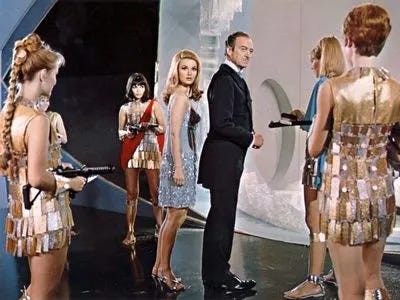
This Bond doesn’t chase desire. Desire orbits him. He’s not a hunter. He’s a center of gravity.
Throughout the film, he’s surrounded by women—young, available, interested. The expected script would be appetite, dominance, conquest. Instead you get... mild awkwardness. Distance. Almost shyness.
That’s not impotence. That’s non-compulsion.
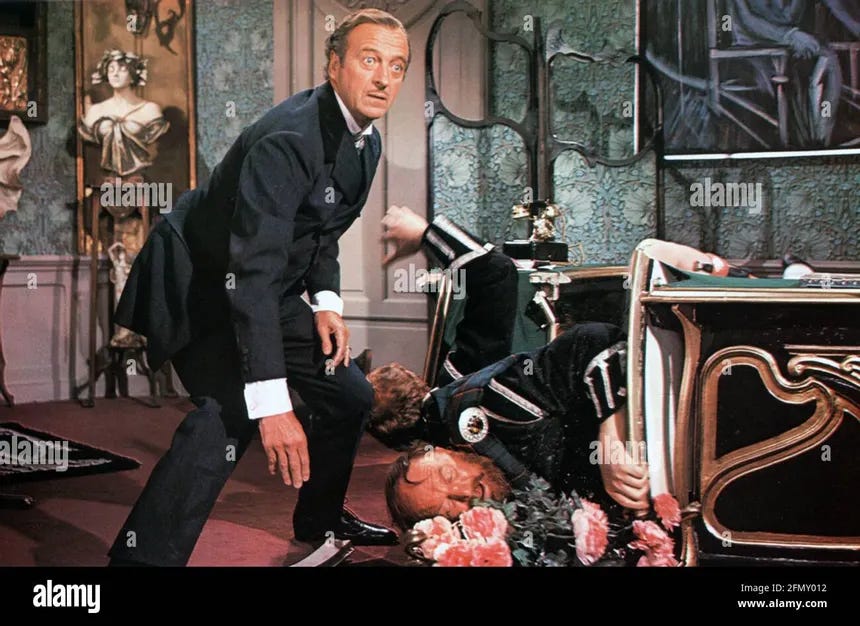
The erotic charge exists. It’s not denied or repressed. But it doesn’t reorganize him. It doesn’t demand action. It doesn’t collapse into identity or story.
[I watched him sit in a room full of dancers moving like snakes—the serpentine movements that evolution designed to capture male attention—and his posture didn’t change. Still. Observant. Not hungry. Not dissociated. Just... uncaptured.]
What My Nervous System Recognized
I’ve spent the last month in a particular kind of training, though I didn’t call it that at the time.
Weeks of silence. Reduced stimulation. Long hours of sitting. Attention sharpening until subtle processes became visible. Watching desire arise without acting on it. Watching attraction form without collapsing into pursuit.
And then I watched this film, and something clicked.
Bond embodies:
Containment without rigidity
Erotic charge without leakage
Gravity without pursuit
Choice without urgency
Women approach him. Situations unfold toward him. He responds when alignment is clear.
No scrambling. No collapse. No proving.
That’s not fantasy for me right now. That’s a template my body is already rehearsing.
Pre-Pendulum Masculinity
In my work on pendulums—the information structures that capture attention and perpetuate themselves through human behavior—I’ve mapped how these entities feed on reactivity, urgency, and identity formation.
Modern masculinity is saturated with pendulums:
The performance pendulum: Constantly signal strength, appetite, capability
The conquest pendulum: Convert attraction into action or you’re defective
The explanation pendulum: Justify yourself, narrate your feelings, be legible
The resolution pendulum: Close every loop, decide every ambiguity, never remain uncertain
The 1967 Bond violates all of them.
He doesn’t over-signal. He doesn’t chase resolution. He doesn’t explain himself. He doesn’t collapse ambiguity.
That reads as awkward to a culture addicted to immediacy and payoff. But to a regulated nervous system, it reads as calm authority.
[This is pre-pendulum masculinity. Before the capture tightened. Before desire became mandate. Before stillness became suspicious.]
The Line That Named the Playbook
Halfway through the film, a villain delivers a line that stopped me cold:
“Our orders were to corrupt you. To befoul your image of yourself. Failing that, we would kill you.”
Read that again.
Corrupt you. Befoul your image of yourself. Failing that, kill you.
That’s the actual sequence. Not attack first. Corruption first.
Pendulums don’t start by destroying bodies. That’s crude and inefficient. They start by corrupting self-image. If they can get you to doubt your own orientation, your own containment, your own legitimacy, they don’t need to kill anything.
You’ll do the work for them.
The Three-Stage Playbook
Stage 1: Corrupt
Interfere with your inner signal. Introduce noise. Confuse desire with entitlement. Confuse restraint with fear. Confuse presence with aloofness.
Stage 2: Befoul your self-image
This is the key move. If a man no longer trusts his stillness, he’ll perform. If he no longer trusts his desire, he’ll suppress or act compulsively. If he no longer trusts his boundaries, he’ll collapse or harden.
Once self-image is poisoned, behavior follows automatically.
Stage 3: Kill
Only if the corruption fails. Only if the person remains oriented, grounded, unhooked. Then the system escalates to exile, ridicule, cancellation, erasure. Symbolic death first. Literal only if necessary.
The Modern Version
The modern mythos runs this playbook constantly:
If you don’t pursue, you’re defective
If you don’t declare, you’re hiding
If you don’t perform desire, you’re suspect
If you hold still, you’re dangerous
That’s corruption of self-image.
A contained man doesn’t over-signal, doesn’t chase resolution, doesn’t collapse ambiguity, doesn’t need to prove innocence or desire, doesn’t outsource orientation to the crowd.
That starves the machine.
So the machine teaches him to distrust his own stillness.
The Scene in the Temple
There’s a scene where Bond is in a Buddhist temple. Women dance around him like snakes—the cobra-head movements, the swaying hips, every evolutionary trigger firing.
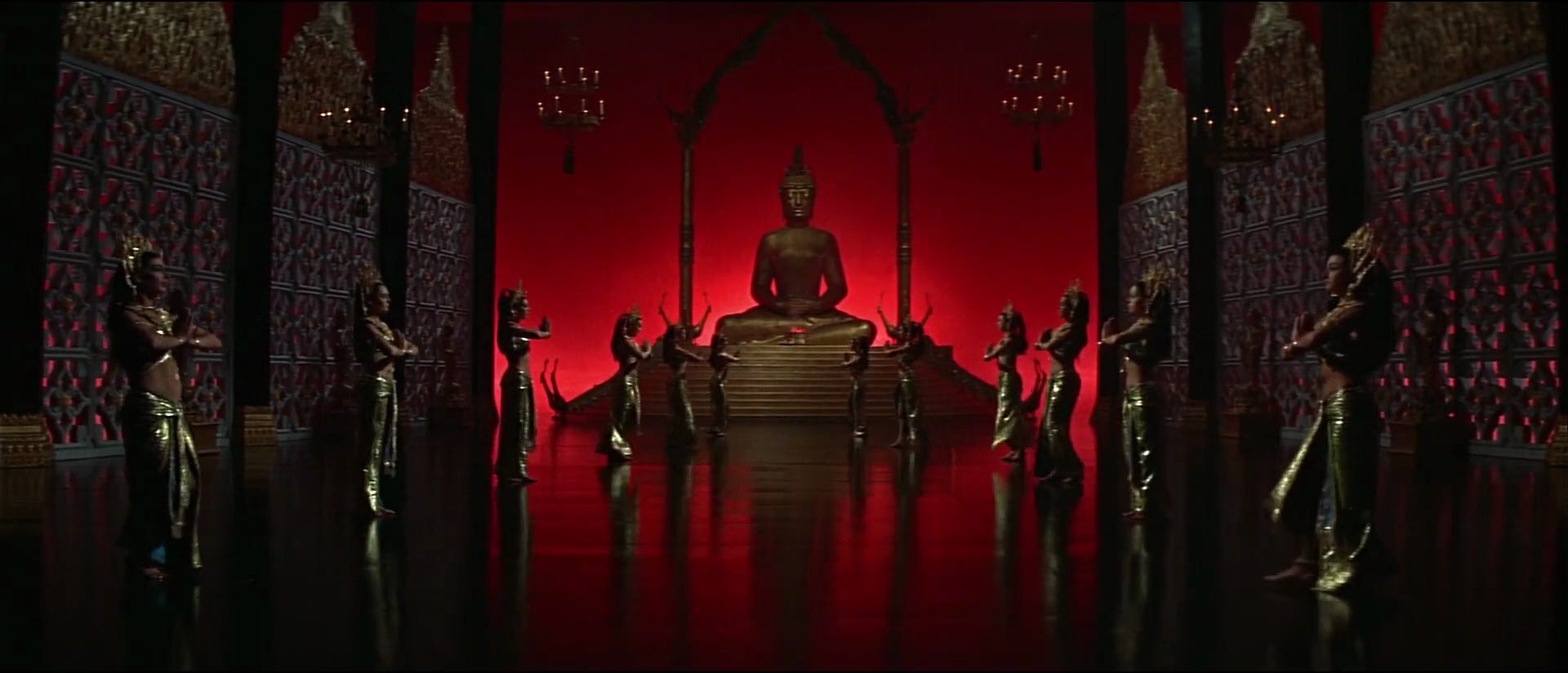
It’s absurd. It’s also precise.
The imagery isn’t accidental. Across cultures, serpentine dance represents sensory salience: movement that captures attention through rhythm, repetition, and mirroring. Film language uses it to show how attention is hijacked before cognition.
But Bond’s posture doesn’t change.
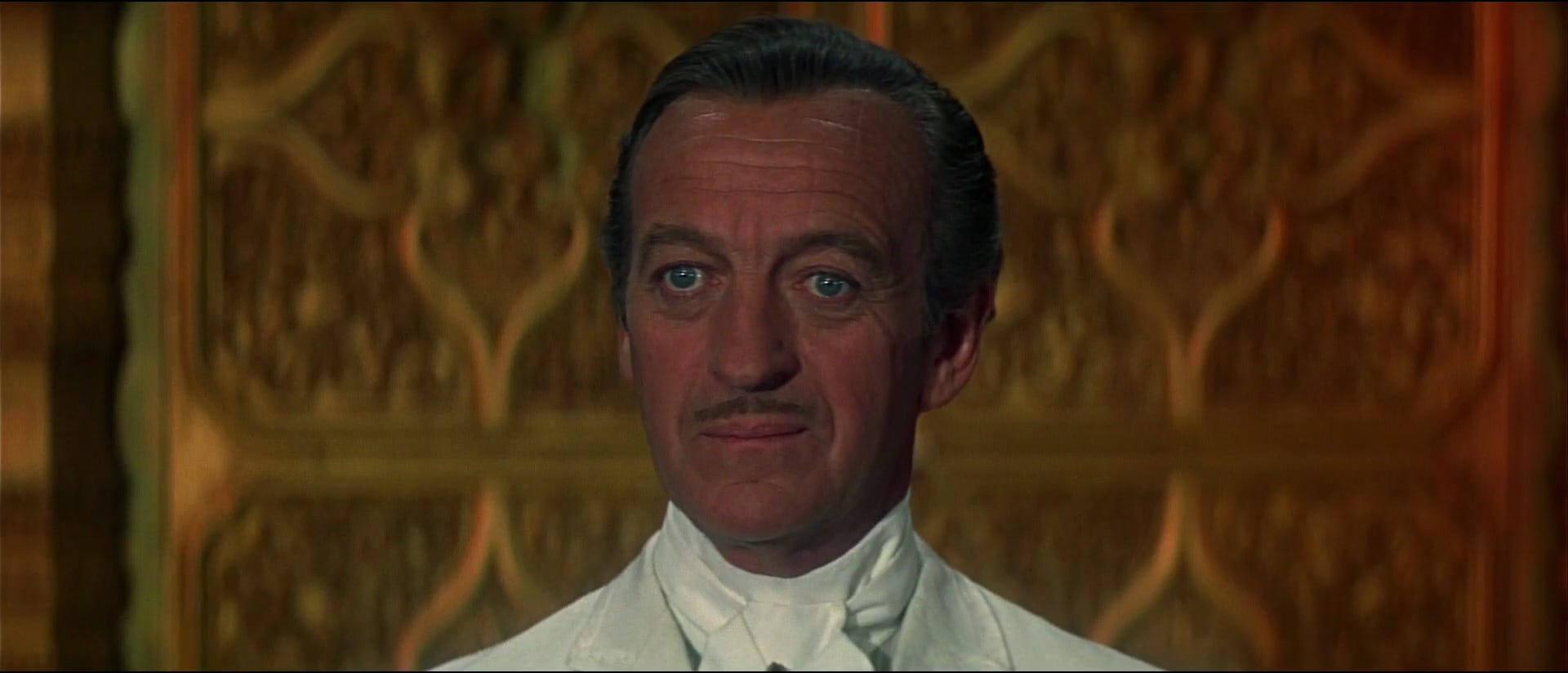
He’s being calibrated, not tempted.
The scene isn’t about resisting women. It’s about remaining unmoved while stimulation exists. Desire can arise. Interest can exist. Orientation stays sovereign.
[I’ve been doing exactly this for weeks without the snakes or the temple. Eye gazing with women in Zen diads. Feeling attraction arise without acting. Feeling the body track without the mind collapsing into story. The same curriculum. Different container.]
Why the Ending Refuses to Resolve
The final casino scene is almost comically non-conclusive.
No emotional confession. No moral wrap-up. No romantic consummation. No explanatory monologue.
Just... continuity without capture.
Everyone around him wants resolution. The organization. The women. The audience. The culture.
Bond declines. Not by saying no. By not needing yes.
He does not collapse the waveform.
Modern storytelling can’t tolerate this. We’re trained to equate meaning with closure. An open loop feels like failure, not power.
But that ending is doing something deliberate:
Nothing is consumed
Nothing is concluded
Potential is preserved without being converted into identity, romance, or narrative payoff
This is what non-capture looks like in narrative form.
The Collective Shift
Something inverted over the decades.
Then:
Masculine power = internal organization → external gravity
Restraint = maturity
Non-pursuit = confidence
Ambiguity = trusted
Now:
Masculine power = expression → visibility → validation
Restraint = pathology
Non-pursuit = fear, repression, or “low T”
Ambiguity = threat
Modern scripts confuse containment with inhibition. They’ve lost the distinction.
The Polarization Engine
Here’s what I saw clearly for the first time watching this film:
When pendulums mature, they stop persuading and start polarizing.
They don’t need coherence anymore. They need friction. Men against women. Desire against restraint. Expression against containment. Everyone forced to pick a side so the system keeps feeding.
Earlier portrayals assumed an underlying shared orientation. Men and women existed inside the same field, even when they were in tension. Attraction was a current inside a larger order. Containment made sense because the ground was shared.
Modern portrayals assume adversarial polarity. Desire must be declared. Power must be proven. Ambiguity is treated as threat. Stillness is suspicious.
That’s not gender collapsing. That’s the middle collapsing.
Pendulums can’t survive the middle. They need extremes. They need instant resolution. They need people to confuse orientation with obligation.
So they rewrite the story:
Containment becomes repression
Attraction becomes entitlement
Boundaries become hostility
Stillness becomes weakness
And slowly, men and women are trained to experience each other not as complementary poles in one field, but as opposing forces competing for narrative dominance.
Three Concepts Worth Naming
1. Narrative Containment
The capacity to let a story remain unfinished without anxiety, justification, or performative distance.
Modern culture treats closure as virtue. In reality, closure is often nervous-system appeasement.
Containment means the character does not orient around being understood. The story continues without converting potential into identity.
One-liner: Containment is when nothing leaks, and nothing needs to be taken.
2. Closure Culture
The collective inability to hold ambiguity.
The more dysregulated the culture, the more it demands narrative resolution. Closure is sold as “emotional intelligence.” In practice, it often forces false decisions.
Open loops used to be trusted. Now they trigger panic.
One-liner: When a culture can’t sit with uncertainty, it turns every moment into a verdict.
3. Gravity Without Grasping
Presence that does not pursue and does not withdraw. Non-reactive orientation.
Gravity is not dominance. It’s not aloofness. It’s staying centered while others orient.
Modern masculinity has been split into predation or passivity, conquest or confession. Gravity is neither.
One-liner: Gravity is what happens when nothing inside you is trying to get somewhere.
What I’m Actually Learning
I didn’t watch this film for entertainment. I watched it as somatic calibration.
My nervous system is in a particular state right now:
Desire without urgency
Attraction without pursuit
Identity without collapse
Presence without performance
That state needed a template. Not a guru. Not a teaching. Just a silhouette and a soundtrack.
The 1967 Bond gave me that.
Not because he’s aspirational. He’s post-aspirational. He doesn’t need to become powerful. He’s already contained.
[I recognized the operating system immediately. Not because I’ve mastered it—I haven’t. Because my body is already rehearsing it. The retreat taught me the mechanics. Bond gave me the aesthetic.]
The Quiet Recognition
What I recognized watching an old Bond film wasn’t nostalgia. It was nervous-system literacy.
A man capable of remaining uncollapsed in the presence of desire, ambiguity, and narrative pressure. He doesn’t reject temptation. He doesn’t dramatize restraint. He simply doesn’t reorganize himself around it.
That capacity has almost vanished from modern storytelling because it has almost vanished from modern bodies.
But it’s not gone.
It’s just underground.
And every man who remembers it—who trusts his stillness, who doesn’t collapse orientation under pressure, who lets desire exist without being consumed by it—becomes a data point that another way is possible.
The pendulums win when people forget this is possible.
They lose the moment someone remembers.
Your Turn
Have you noticed how modern films handle masculine stillness?
Can you think of a recent portrayal where a man holds desire without pursuing, ambiguity without resolving, presence without explaining?
What happens in your own body when you stay oriented without collapsing?
The template exists. It predates polarization. It’s still available.
You might already be living it.
Keep bending light and hacking minds,
Cian
P.S. This piece connects to “Every Woman I’ve Loved Was Trying to Tell Me the Same Thing”—my New Year’s article on the pattern every partner was pointing at. The Bond portrayal is the cinematic template for what I finally learned to embody: gravity without grasping.
P.P.S. The line about corruption and killing is the most honest thing I’ve ever heard a villain say. Most adversarial systems don’t announce their playbook. This one did: First corrupt self-image. Then watch behavior follow. Only kill if corruption fails. That’s the sequence to watch for—in media, in culture, in your own mind.
P.P.P.S. Yes, I’m aware that recommending a 1967 satirical Bond film as masculine training material sounds absurd. That’s part of why it works. The absurdity disarms the ego. The signal gets through anyway. 🎰🕶️