
Every Woman I've Loved Was Trying to Tell Me the Same Thing

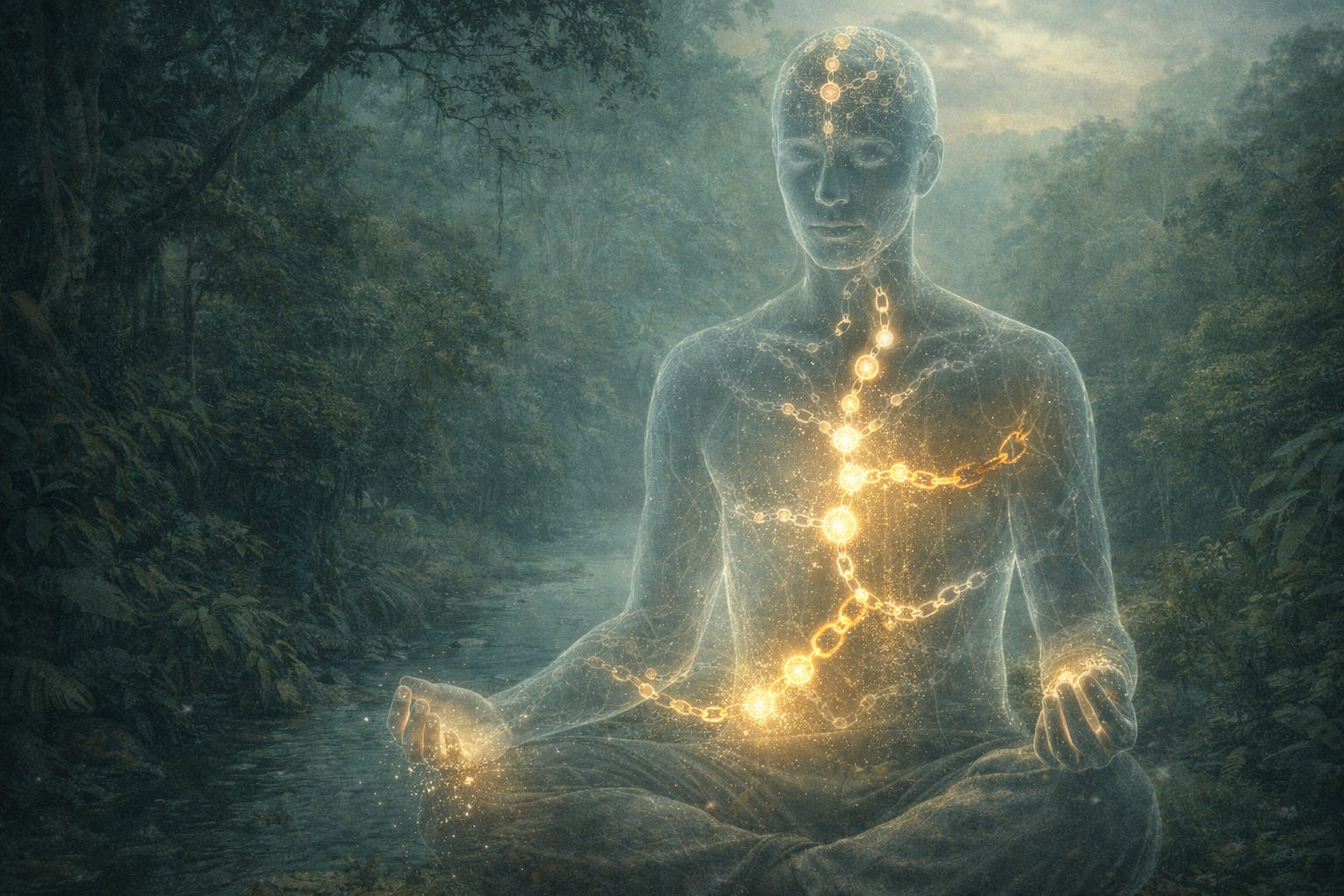
Today is December 31st. The last day of a seven-year cycle.
Seven years ago, near the end of an eighteen-year relationship, I made a choice I’d never made before: I chose myself. I didn’t know what that meant. I just knew that something had to change, and I was the only variable I could actually move.
What followed was seven years of transformation—three significant relationships, each one a mirror I wasn’t ready to look into. Teachers I sought out and teachers who arrived uninvited. Spiritual experiences that cracked me open and psychological work that put me back together differently. A slow, sometimes brutal education in how I actually operate.
[Writing this from a cabin in the Costa Rican jungle, still processing weeks of silence, sweat, and the slow demolition of things I thought were “me”...]
And now, sitting at the end of this cycle, I finally understand what every partner was trying to tell me. They didn’t have the language for it. Neither did I. But they could feel something I couldn’t see—a pattern running underneath all my good intentions.
This is the story of how I learned to see it too.
Most conversations about desire start too late.
By the time you’re “deciding” whether to act, whether to resist, whether to indulge—the system is already running. The machinery that creates wanting, that creates the wanter, has already assembled itself.
I didn’t set out to study Buddhism. I wasn’t trying to fix my relationship to desire. I was watching something strange happen in my attention.
It started with a somatic release that emptied my nervous system. Then weeks of no sexual desire—not through discipline, not through vows. The impulse just... stopped arising. What appeared instead was something I’d never had enough stillness to see: the machinery that runs before desire.
And only later did I realize I’d been watching the chain itself.
The Night the System Emptied
Let me start where this actually started.
A night of shaking. Dread without narrative. My body making sounds I didn’t choose—moans, shuddering breaths, waves of grief with no story attached. This wasn’t catharsis. It wasn’t trauma release as performance. It was more like something that had been running for decades finally exhausted itself.
I woke the next morning feeling like a dead insect. Nervous system emptied. No agency, no meaning-making, no forward momentum.
And then: nothing.
For two and a half weeks, sexual desire vanished. Not suppressed—I wasn’t white-knuckling anything. Not spiritually bypassed—I wasn’t telling myself I’d “transcended” it. The machinery just wasn’t generating output.
This wasn’t peace. It was winter. Internal weather I’d never experienced because I’d always been stoking the fire.
My somatic coach has a teaching about “wintering”—that transformation requires periods where the old self dies and something new gestates. But you can’t force wintering. You can’t will yourself into containment. Either the system has exhausted itself, or it hasn’t.
Mine had. The energy stopped looking for exits. I wasn’t doing containment—I was in a contained state. The difference is everything.
[Previous abstinence had required effort. This was different. The energy stopped looking for exits. Containment became a state, not a strategy.]
What Silence Reveals
Then I entered silence. Ten days of a silent retreat in Costa Rica, followed by more solitude. Reduced stimulation. No familiar outlets. Long hours of sitting. Attention sharpening until subtle processes became visible.
And that’s when I started noticing the tracking.
During meditation, I’d catch my mind doing something strange. Certain people—women I found attractive—would move from background to foreground in my awareness. Not through thought. Not through decision. Through something more primitive.
My body was orienting.
I noticed it tracking proximity. Where is she sitting relative to me? I noticed it tracking movement. Is she walking toward or away? I noticed attention narrowing, leaning in a direction before any conscious thought arose.
The mind wasn’t fantasizing yet. The body was positioning. Something was happening before wanting.
I started watching this with fascination instead of acting on it. And what I saw changed how I understand desire.
Orientation: The Missing Link
Here’s what most models of desire miss:
They focus on the moment of wanting. The choice to act or not act. The moral question of good desire versus bad desire.
But there’s an earlier layer. Call it orientation.
Orientation is where attention and energy lean before craving arises. It’s not action. Not intention. Not identity yet. Just... directionality.
During the retreat, I watched it happen in real time:
Attention tracking a woman’s proximity—she’s three people away in the lunch line
Body subtly repositioning—angling slightly so she’s in peripheral vision
Awareness narrowing—other stimuli fading, this one amplifying
A sense of something pending—uncertainty that wants resolution
None of this was conscious choice. I wasn’t thinking “I want her.” The system was simply orienting—tagging something as salient, directing resources toward it, preparing for... something.
[I realized I’d spent my entire adult life living downstream from this process. By the time I was “deciding” anything, orientation had already occurred. The game was rigged before I sat down at the table.]
The Neuroscience Lens
Let me put a different frame on this before we get to Buddhism.
Modern neuroscience has mapped some of what I was watching:
Salience: The brain’s process of tagging something as “important.” This happens automatically, below conscious awareness. Before you decide something matters, your brain has already flagged it.
Attentional capture: When stimuli pull focus without your consent. Certain patterns—movement, contrast, anything that might be threat or opportunity—hijack attention before you can evaluate them.
Predictive processing: The brain trying to reduce uncertainty. When something is tagged as salient but not resolved, the system generates increasing energy toward resolution. This feels like anticipation. Like wanting. But it’s actually uncertainty management.
Hypervigilance: What happens when the uncertainty involves potential mates or threats. The tracking I noticed during the retreat—where is she, is she watching me, are we going to interact—is the same circuitry our ancestors used for survival. I was running prey-predator software on romantic attraction.
The insight that landed: Much of what I’ve called “attraction” is actually uncertainty reduction behavior. The system tags someone as salient, creates uncertainty about outcome, then drives attention toward resolution. This feels like desire. But the desire is downstream from something more primitive.
I wasn’t wanting yet. I was orienting. The nervous system assigns priority before it assigns meaning.
Two Kinds of Activation
Somewhere in the second week, I noticed something crucial.
The retreat used a practice called Zen Diad—koan work done in pairs. You sit across from someone, eye gazing, and take turns. One speaks, one listens. You become a mirror for whatever arises in them.
Different women created completely different responses in my body. Not just “attracted” versus “not attracted.” Different kinds of activation.
One woman—call her the first—created:
Agitation
Urgency
Narrowing
Animal pull
A sense of being drained
Another woman—call her the second—created:
Softening
Settling
Nervous system downshift
Armor dissolving
A sense of being filled
With the first, I noticed my body tracking her constantly. Where was she sitting? Was she in my field of view? When would we interact? Energy bleeding outward, attention pulled from center.
With the second, I noticed my body... relaxing. When we sat across from each other in the diad, I felt myself sink into my seat. Stuff I didn’t know was active started turning off. My system was deactivating.
[This wasn’t theory. It was felt distinction. The first was like a hypnotic pull—cobra-head movements, hips swaying, biology hijacking attention. The second was like coming home—warmth, safety, the kind of presence that doesn’t demand anything.]
The contrast gave me my first data point for something I’d heard but never understood viscerally:
Activation is not intimacy. Deactivation is not boredom.
One drains. One grounds.
And the tracking—the hypervigilant orientation—only happened with the activating presence. The grounding presence didn’t require tracking. My system could rest.
My coach calls this the difference between Level 2 and Level 3 relating. Level 2 is polarity—leading, creating attraction, managing the dance. It works, but it requires constant energy expenditure. Level 3 is gravitational. You hold your own field, stay grounded in your vibration, and let what’s aligned come to you.
With the first woman, I was in Level 2 without choosing it—my system pulled into the polarity game automatically. With the second, I dropped into Level 3 without trying—my system just... settled.
The chain only ran hard when the field was destabilized. When the field was grounded, there was nothing to track.
The Break in Containment
I want to be honest about what happened next, because this isn’t a success story.
After days of effortless containment—no discipline required, energy simply not looking for exits—something broke open.
Porn (its been months...). Ejaculation. Followed immediately by grief.
Tears during release. A name surfacing in my mind unbidden. Emotional truth flooding in after the physical discharge, not before.
[I said “I love you” to someone not present. The words came out of nowhere. Or rather—they’d been held somewhere, and the release cracked the container.]
This wasn’t failure. It wasn’t regression. It was a pressure release revealing what was actually being held. I’d thought the containment was integration. It was actually suppression’s more sophisticated cousin. The system found an exit because something needed to exit.
What I learned: Containment without integration creates pressure. The energy has to go somewhere. If it’s not metabolized, it gets stored. And stored charge eventually discharges.
My coach’s framework names this: “Wintering well means still working and functioning in your life... it’s just slower and quieter and we invite more white space.” But if wintering becomes numbing—escape dressed as retreat—the pressure builds underground.
I’d been wintering well until I wasn’t. The porn wasn’t desire. It was a pressure valve for something that needed to be felt, not released.
Anger Without Object
In the days that followed, something shifted.
I found myself increasingly irritated with the teachings. The facilitator’s words, which had seemed fine before, now landed as platitudes. Just be aware. That’s all you need. I wanted to say: Awareness of what? How? Teach something, for Christ’s sake.
I started withdrawing. Skipping sessions. Sitting by the river instead of the meditation hall. Feeling done.
[The anger was real. But the target was incidental. When I looked underneath, there was no actual grievance—just heat. Just something wanting out.]
Here’s what I recognize now: Anger often marks identity reorganization. Old scaffolding collapsing. The parts that built themselves around certain structures suddenly finding those structures missing.
I wasn’t angry at the teacher. I was angry at... I don’t know what. The anger just existed. It needed expression, so it found a target.
This is part of what makes this territory destabilizing. Seeing earlier layers doesn’t create peace immediately. It often releases stored emotion—grief without story, anger without object, sexual energy without outlet.
It looks like regression. It’s actually unbinding.
What the River Knew
The morning after the worst of it, I went to the river.
Sat in moving water for an hour and a half. Let it flow around and through. Felt something I can only call mother nature touching me. Water sprites dancing at the edge of perception. The world saying: I’ve got you.
No teaching. No practice. Just contact.
And my system regulated in ways an hour of dharma talks couldn’t touch.
[The words never helped as much as the water. The concepts never landed as deeply as the sensation of cold current pulling heat from my legs. Regulation happened through contact, not instruction. Awareness didn’t need explanation—it needed earth.]
The Map Clicks
It wasn’t until after the retreat that I realized I’d been watching something ancient.
The Buddha mapped this 2,500 years ago. He called it dependent origination (pratītyasamutpāda)—the chain of conditions that create suffering.
Here are the relevant links:
Contact (phassa): Raw sensory input. Something touches awareness.
Feeling tone (vedanā): The immediate categorization—pleasant, unpleasant, or neutral. This happens automatically, before thought.
Craving (taṇhā): The urge to hold onto pleasant, push away unpleasant. The first movement of wanting.
Clinging (upādāna): Identity forms around the wanting. “I am someone who desires this.”
Becoming (bhava): A mode of being comes online. The whole self-system reconfigures around the desire.
Birth (jāti): A “someone” is born. “I” who wants. “I” who suffers.
The Buddha’s revolutionary insight: Liberation appears at the moment of feeling tone.
Not at suppression. Not at renunciation. Not at the level of action or choice.
At seeing.
If feeling is seen clearly—if the pleasant/unpleasant tag is noticed as it arises—craving doesn’t have to follow. The chain can be interrupted before identity forms.
[I hadn’t read about dependent origination in years. But there it was, playing out in my nervous system exactly as mapped. Contact → feeling → craving → “I want” → suffering. The chain was always running. I’d just never been still enough to see it link by link.]
Where Māra Appears
In Buddhist mythology, Māra is the tempter who appears to the Buddha on the night of awakening. He sends his daughters—desire, aversion, delusion. He sends his armies—fear, doubt, restlessness.
But here’s what most people miss:
Māra doesn’t appear at the beginning of the path. He appears at the threshold of stabilization.
After the Buddha had done the work. After clarity. After renunciation. Right before awakening.
And what does Māra actually say? Not “go be immoral.” He says:
Who are you to sit here?
You still desire.
You still feel attraction.
You still imagine futures.
You’re still oscillating.
Māra, in my pendulum framework, is the highest-level pendulum that tries to reconstitute a central ‘I’ once the lower pendulums lose their grip.
It’s not the sex pendulum. Not the romance pendulum. Not the validation pendulum.
It’s subtler.
It’s the voice that says: “Sure, you’re free... but who will you be with? Which future is yours? Choose. Collapse. Resolve.”
[That voice ran constantly during the retreat. “Is it her? Is it the one I am still in Love with? Is it the other one? Is it someone I haven’t met yet?” The demand to resolve uncertainty, to crown a winner in the internal auction. That demand is Māra. Not because it’s evil—because it demands resolution before reality has resolved itself.]
Why It Felt So Intense
In the myth, Māra escalates because the old strategies stop working.
Notice the sequence in my lived experience:
Sexual compulsion fell away
Containment stabilized without effort
Attention sharpened
The chain became visible earlier than usual
Desire still arose—but without fantasy
Aversion arose—but without justification
Anger arose—but without a true object
That’s exactly how Māra appears when identity is no longer doing the work. He shows up as raw force instead of story.
When the usual pendulums can’t capture attention through their familiar narratives, the energy doesn’t disappear. It intensifies. It looks for any exit. And the demand to collapse—to choose, to resolve, to become someone again—gets louder precisely because it’s losing.
What the Buddha Actually Did
The Buddha didn’t choose between Māra’s daughters. He didn’t reject them either.
He simply stayed seated.
He touched the earth. Grounded awareness below the committee. Let the temptations arise and pass without someone inside claiming ownership.
In pendulum terms: He stayed in containment. Stayed in non-collapse. Stayed prior to narrative. Stayed as the space where attraction arises and passes.
That’s why Māra leaves.
Not because he’s defeated. Because he’s unfed.
The auction continues. But no one’s buying.
What Actually Changed
Let me be precise about what shifted.
Desire still arises. Attraction still happens. Beauty still lands. I watched a woman dance at the retreat—tribal movements, hips swaying, every evolutionary trigger firing—and my animal wanted to consume her. That hasn’t disappeared.
But:
The chain is visible earlier. I can feel orientation happening before wanting. I can sense the body tracking before the mind narrates.
Craving is less automatic. There’s a gap between feeling tone and the urge to resolve. In that gap, choice becomes possible.
Identity forms less often. The story of “I am someone who wants this” doesn’t crystallize as quickly. Sometimes it doesn’t crystallize at all.
Activation versus deactivation is legible. I can now feel the difference between someone who dysregulates my system and someone who grounds it. This changes everything about approach.
My coach would say this is the shift from “wide-open field, broadcasting, pulling” to “contained, intentional, gravitational.” The same women are out there. But my field is different. And the chain, when it does run, runs slower—because my energy isn’t already dispersed, already tracking, already orienting toward every possibility.
The body always knew what I needed. I just wasn’t still enough to hear it.
[I didn’t stop wanting. I started seeing sooner. Freedom didn’t come from control. It came from timing—catching the chain before it bites.]
The Chain Only Binds When It’s Invisible
Here’s the teaching that landed:
Suffering doesn’t begin at desire. It doesn’t begin at action. It begins at unseen orientation.
When the system tags something as salient—and you don’t notice the tagging—you’re already captured. Craving follows automatically. Identity crystallizes around the craving. And now you’re someone who wants something, someone who’ll suffer when they don’t get it, someone trapped in a chain they never saw forming.
But when orientation is seen? When the tagging is noticed in real time?
The chain slows. Sometimes stops.
Not because you’ve repressed anything. Not because you’ve transcended desire. Because visibility changes the dynamics.
The chain only binds when it’s invisible.
What They Were All Trying to Tell Me
Here’s something I didn’t expect to see until I sat down to write this.
Every significant partner I’ve had in the last seven years was pointing at the same thing. They didn’t have the language for it. Neither did I. But now I can translate what they were saying.
One told me my “leaky sexual energy” was my biggest problem. Not that I cheated or acted inappropriately—I didn’t. It was energetic. Something about the way I broadcast, the way my field was always open and scanning. She could feel it even when I wasn’t doing anything.
Another told me that the only part of me that scared her was a “teenager” version—constantly scanning for opportunity, sexually charged, never quite still. She wanted me to be chill. Contained. Non-grasping. Not future-projecting or planning our life before we’d lived it.
An eighteen-year relationship ended partly because I evolved and she didn’t follow—but also because I’d never learned to hold my own field. Energy leaked. Attention wandered. The container couldn’t hold what wasn’t contained.
[They were all saying the same thing in different dialects: “Stop pulling. Stop scanning. Stop orienting your whole system around uncertainty resolution. Just be here. Let me come to you.”]
I couldn’t hear it then because I didn’t have the framework. Containment sounded like repression. Stillness sounded like passivity. Non-pursuit sounded like giving up.
Now I understand: they were asking for gravity.
Not dominance. Not withdrawal. Just a man who could hold his own center while attraction existed. A field that didn’t leak. Presence that didn’t demand resolution.
My coach calls this “closing the field”—pulling energy next to the skin instead of broadcasting it wide. She says women feel it instantly: the difference between a man who is available to everyone and a man who is intentional about where his energy goes.
What I’m learning now is what they were all trying to teach me.
The chain they were pointing at—the one that ran from salience to tracking to craving to grasping—was visible to them before it was visible to me. They felt it in my field. They named it with whatever words they had.
I wasn’t ready to hear it.
I am now.
What Remains Unfinished
I want to be clear: This isn’t an enlightenment story.
I broke containment. I watched porn. I cried. I got angry at a teacher who didn’t deserve it. I’m still holding multiple possibilities about my romantic future without resolution, and sometimes that feels like freedom and sometimes it feels like fog.
The insight is real. The integration is incomplete.
But maybe that’s the point.
The chain doesn’t need to be destroyed. It just needs to be seen.
And every time you catch it forming—feel the orientation before the wanting, notice the tracking before the story—you buy yourself a moment. A breath. A choice.
That moment is liberation. Not the end of the chain. Just the recognition that you’re not the links.
[The retreat is over. I’m sitting in a cabin, writing this by lamplight, still not sure what’s next. Heart still oriented toward someone. Body still learning the difference between activation and grounding. Mind still running old programs occasionally. But something’s different now. Something sees. And the chain, when seen, loosens its grip.]
Your Turn
Can you catch orientation happening?
Can you feel the body tracking something before the mind says “I want”?
What happens when you notice the tagging—the pleasant/unpleasant assignment—before craving crystallizes?
These aren’t philosophical questions. They’re empirical. You can look right now.
The chain is probably running. It usually is.
But you might be able to see it.
And seeing changes everything.
Keep bending light and hacking minds,
Cian
P.S. This piece connects to the Pendulum Series—particularly “The Pendulum of Self” on how identity is a committee of competing bidders. What I’m describing here is the micro-level of that process: watching a specific pendulum (desire, attraction) try to capture the spotlight and form an “I” around itself. The chain of dependent origination is the mechanism. The pendulum framework is the ecology. Same truth, different zoom level.
P.P.S. The Buddha placed liberation at the moment of feeling (vedanā)—not at action, not at renunciation. This is radical. It means freedom isn’t about being good or resisting temptation. It’s about seeing clearly enough that the chain doesn’t get momentum. You can feel attraction completely and let it pass completely—no one needs to be born who wants, no one needs to suffer when they don’t get.
P.P.P.S. For those wondering: I still don’t know how the romantic situation resolves. I’m learning to let that not-knowing be information rather than emergency. The heart knows what it knows. The chain doesn’t need me to collapse the waveform prematurely. 🔗
Cian I can't thank you enough for helping me understand my work at a new level through this essay. I have a few clients doing this kind of integration - moving my thesis into their own language, deepening it through their lived experiences, making it into the medicine that serves people they can relate with - and it's an exchange in co-creation I had always hoped for. I am going to read this a few more times!
Ok sheer curiosity kept me reading, and I believe this is the most grounded you're becoming, I sense it, stay there, let it take root and stabilize the electricity and its inner fire. And trust in the process without the mental formations 😉.
I realize you didn't ask but I'm gonna share what's arising to share anyway 🤣
As I read to the end, I thought omg, he needs to stay there at Patcha Mama a little longer 🤣. Because returning to the electrical energy field and its frequencies that draws your energies up into those areas u mentioned will pull you back into the mind, its mental constructs and out of Presence with the new frequencies/grounding being weaved atm.
Don't feel guilty about the discharge, you humananed, and your being was in awareness. Although this is very rare for me and using visualization; I've had to do that to create space at times too in the past. And having come out the other side, I'm at peace.
The mind doesn't tell us that in the circumstance because you're "in awareness", you did what was necessary to help the energetic buildup move via n out of you 🤔, its like "creating some space" for the new to emerge. It cannot emerge where there is no space 🤔.
Uncertainty is like a thief that preys on your vulnerability, and softening can feel vulnerable, it is not the way the masculine mind thinks.
And the lesson becomes, healing the underlying "aversion" and all of its interconnection of guilt, shame, self-crucifixion you felt, created, and did every time you embraced your human desire because of all the judgements around it. Remember, its also "NOT" all yours, some if not majority is "collective programs too" of "how" we were taught to wield these energies not necessarily for our highest outcome... lots of Pendulums here, you're in the heart of its healing.
Stillness can only emerge after we're deeply grounded. Allow this grounded magnetism to expand "slowly" as you connect with "your inner body".
After we've moved out of our way, Stillness comes to the forefront to do what it does, sometimes its silent, other times via words 😉 and you learn to "trust" whats happening without conceptualizing it, and we don't get to control or direct it, IF we try, then thats ego back online 😊.
Eckhart says, you can choose: Stillness, Ego, or the Pain-Body.
I'm deep in my practices of Stillness 😇🙏✨️. See you on the other side 🙏😇✨️