
When Tantric Breathing Breaks the VO2 Max Algorithm: What 20 Years of Practice Actually Does to Your Body

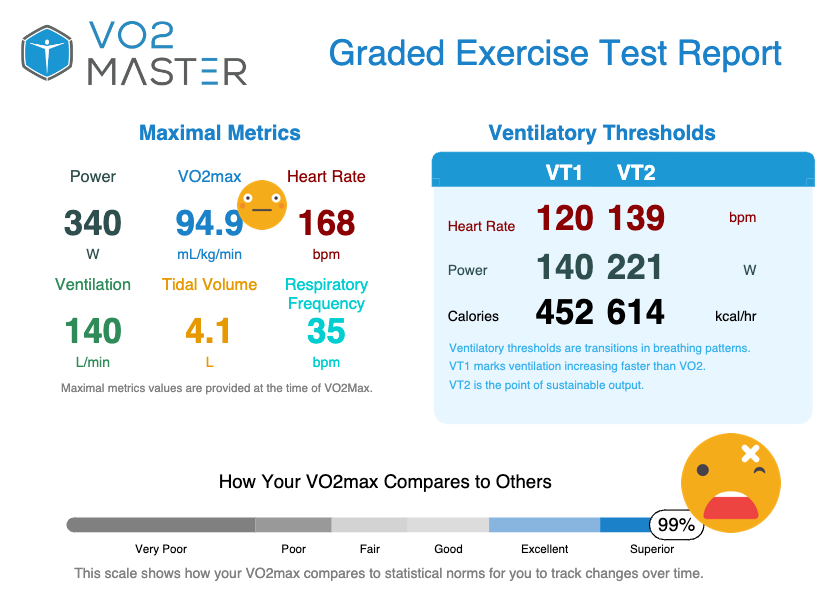
I went to get a VO2 max test and broke the algorithm.
The machine said I’m in the top 1% of Olympic athletes. 99th percentile. Elite endurance capacity rivaling professional cyclists and marathon runners.
I fed the data to GPT-4 for analysis.
Its response? “Don’t build an identity on this.”
[Sitting here laughing at my phone. An AI just told me to check my spiritual ego about fitness data. The irony is not lost on me...]
Then came the kicker: “You’re not a high-elevation Olympic athlete in the top 1% of the top 1%.”
Wait... what?
See, there was a problem. A big one.
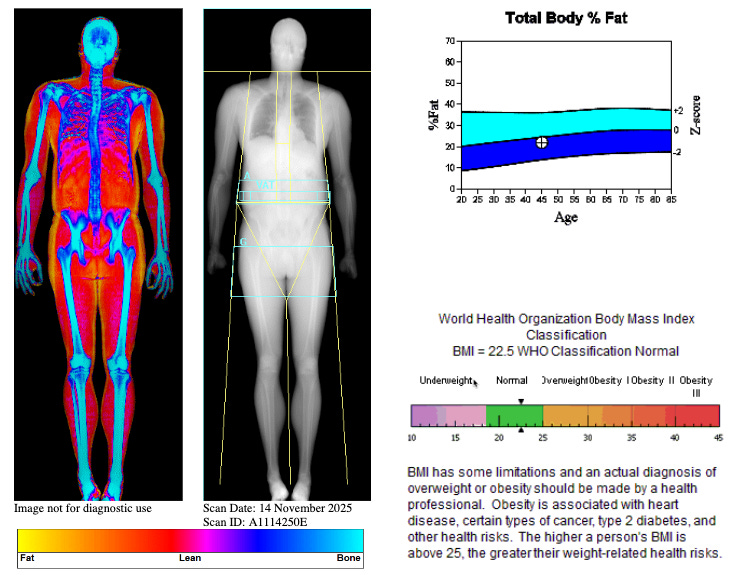
My body composition doesn’t match the numbers. At all.
Body fat: 22%
Lean mass: Good but not exceptional
Training regimen: Moderate at best
Elite athletes with my supposed VO2 max? They’re running 7% body fat. Training 20+ hours per week. Built like goddamn machines.
Me? I gave up the stringent forcing lifestyle years ago. Used to be 7% body fat when I was eating zero carbs and training hard. But that level of control... it was too much forcing. Too much grasping.
So I let it go. Softened. Stopped optimizing my meat suit and started optimizing consciousness instead.
Which means either:
The test is wildly inaccurate, or
Something about my physiology broke the algorithm
Turns out it’s #2.
And the reason WHY it broke reveals something profound about what 20+ years of yogic, tantric, and Zen practice actually does to your body at a measurable, physiological level.
[This is the part where biohacking meets consciousness training and the data gets weird...]
The Test: When Your Buddy is a Biohacker MD
My buddy—doctor, biohacker, general health optimization enthusiast—invited me to BodyStats in Vancouver for comprehensive metabolic testing.
VO2 max test + DEXA scan. Full body composition analysis. The whole quantified-self experience.
For context: He is FIT. Trains consistently. Excellent baseline health. The kind of guy who optimizes everything and has the discipline to maintain it.
I’m... not that guy. Not anymore.
I meditate daily. Practice pranayama. Do some movement. Kickboxing 1-2 times a week. Dancing regularly. But I’m not training for performance. I’m training consciousness. There’s a difference.
So we show up, get hooked up to the equipment, and start the graded exercise test.
You’re on a stationary bike with a mask measuring every breath. Heart rate monitor. Power output tracked in real-time. They increase the resistance every few minutes until you physically can’t continue.
It’s supposed to find your VO2 max—the maximum amount of oxygen your body can utilize during intense exercise. The gold standard measurement for cardiovascular fitness and aerobic capacity.
Average person: 30-40 mL/kg/min
Well-trained athlete: 50-60 mL/kg/min
Elite endurance athlete: 60-80 mL/kg/min
The test ends. I’m gasping, sweating, done.
The technician looks at the screen. Looks at me. Looks back at the screen.
“Uh... your VO2 max is 94.9.”
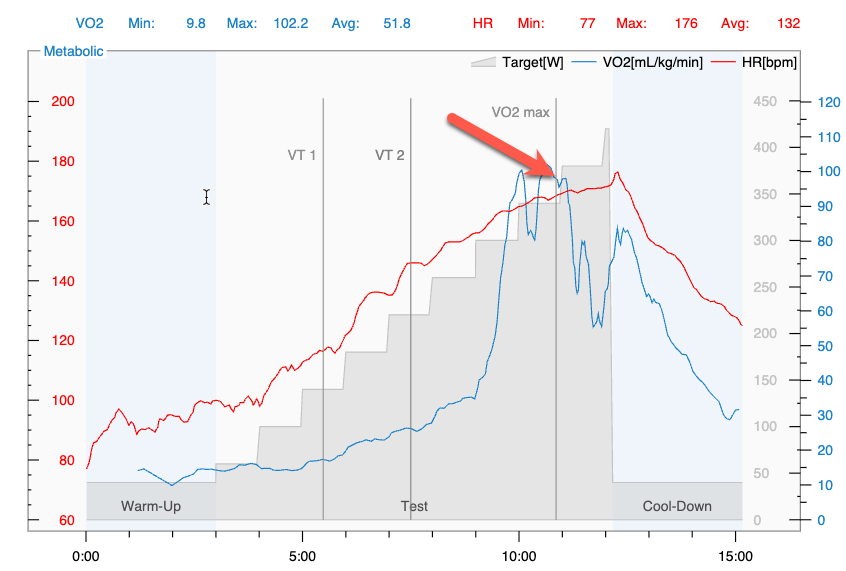
I blink. “Is that... good?”
“That’s 99th percentile. Elite athlete range. Like, Olympic cyclist range.”
I laugh. “That can’t be right.”
But there it was, in the official report:
VO2 Max: 94.9 mL/kg/min
Top 1% of the population. Superior category. The algorithm classified me alongside professional endurance athletes who train 20-30 hours per week.
[This is the moment where you either build an identity on the data... or you get curious about why the data is lying...]
The Break: When GPT Calls Bullshit on Your Superhuman Fantasy
I sent the results to GPT-5 with my DEXA scan for analysis.
Here’s what it said:
“Based on your body composition (22% body fat, moderate lean mass) and the non-linear relationship visible in the Performance Load vs VO2 graph, the algorithm likely misclassified your VO2 max. You’re not a high-elevation Olympic athlete in the top 1% of the top 1%. The software assumed a linear power-to-oxygen relationship that doesn’t apply to your physiology.”
Then came the spiritual coaching I didn’t ask for:
“Don’t build an identity on this number. It’s an artifact of how your body processes oxygen differently than the model expects—likely due to your yogic breathing patterns creating unusually high tidal volume and low respiratory frequency.”
I sat there staring at my screen.
An AI just told me:
I’m not actually superhuman
I broke the test with my breath
Stop making this mean something about my identity
The accuracy was devastating.
[Twenty years of Zen training and I still got caught building a self-concept on fitness data. The algorithm broke. My ego tried to claim it. GPT said: Not today, buddy...]
But here’s where it gets interesting: WHY did my physiology break the algorithm?
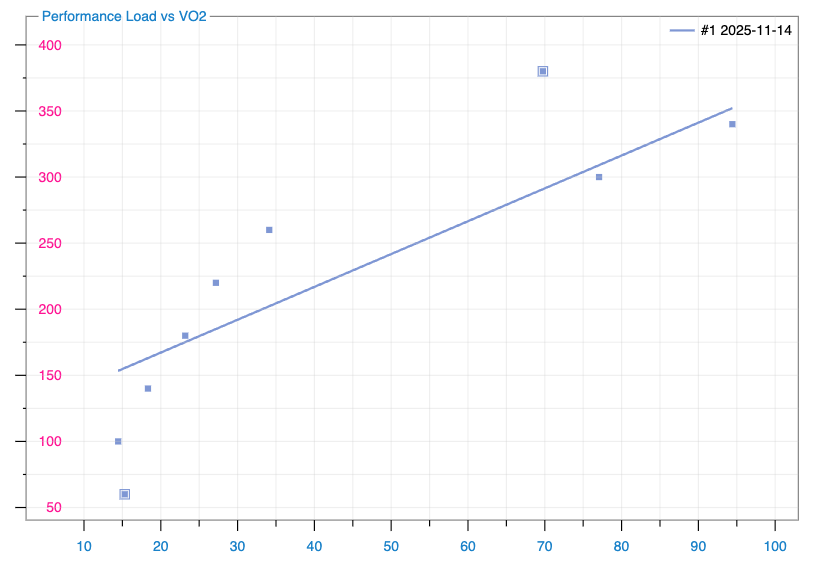
Look at that graph. See those dots? They’re supposed to follow a straight line—more power = more oxygen consumption, linear relationship.
Mine doesn’t. The curve bends. The relationship is non-linear.
The software expected:
Linear increase in oxygen consumption with power output
Standard tidal volume (2-3L per breath)
Standard respiratory frequency (40-50 breaths/min at max effort)
Typical heart rate response for age
What I actually did:
Tidal volume: 4.1L (massive—whale-sized breaths)
Respiratory frequency: 34.5 breaths/min (LOW for max effort)
HR max: 168 bpm (extremely efficient cardiovascular response)
Non-linear power-to-VO2 curve (the algorithm’s nemesis)
The algorithm saw the total oxygen consumption and said: “Elite athlete!”
Reality said: “Nah, just a guy who’s been doing pranayama for 20 years and breathes weird.”
The Real Numbers: What Actually Happened
So we ran a non-linear regression analysis on the data.
GPT helped me recalculate using a polynomial fit instead of the linear model the software assumed.
Adjusted VO2 max estimate: ~50-60 mL/kg/min
Still excellent. Still well above average. Solidly in the “very fit” category for a 45-year-old.
But NOT “top 1% of Olympic athletes” territory.
Which makes way more sense when you look at my DEXA scan:
Body Composition Breakdown:
Body fat: 22.0% (slightly below average male, nowhere near elite)
Lean mass: 154.99 lbs (above average for height, but not exceptional)
Visceral fat: 645g (slightly high—145g above average male…darn I gotta stop eating carbs again - being vegetarian is harder than carnivore!)
Bone density: 1.284 g/cm² (above average—good from weight-bearing practice)
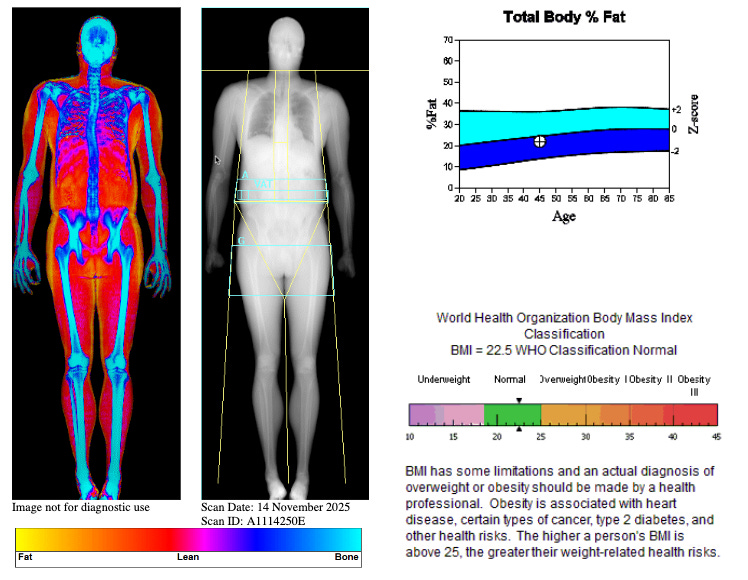
Compare that to my buddy’s results:
His VO2 Max: 50.2 mL/kg/min (excellent, appropriate for his body composition)
His body fat: Lower than mine
His training volume: Higher than mine
His power output at max: 380W (higher than my 340W)
His is STRONGER. More powerful. Better trained.
But my VO2 number came out higher because I process oxygen differently.
Not better. Not worse. Just... differently.
The algorithm couldn’t account for that. So it broke.
[This is what happens when you optimize for consciousness instead of performance. Your body starts doing things that don’t fit the models...]
The Physiology: How 20 Years of Practice Changes Your Body
Here’s what actually happened, physiologically.
1. Tidal Volume: Pranayama Rewires Your Lungs
Normal tidal volume at max effort: 2-3 liters per breath
My tidal volume: 4.1 liters
That’s not normal. That’s not even athlete-normal.
That’s pranayama normal.
See, I’ve been practicing yogic breathing techniques for over 20 years:
Nadi Shodhana (alternate nostril breathing)
Kapalabhati (skull-shining breath)
Bhastrika (bellows breath)
Tummo (Tibetan inner fire breathing)
Tantric breath retention practices
These aren’t just “breathing exercises.” They’re systematic training to increase lung capacity, strengthen the diaphragm, and maximize oxygen extraction per breath.
The result?
My lungs learned to move MASSIVE volumes of air with each breath.
When most people hit maximum effort, they breathe shallow and fast—lots of small breaths trying to get enough oxygen.
My body does the opposite: Fewer breaths, WAY deeper.
It’s more efficient for oxygen extraction. But the algorithm wasn’t built for it.
The software saw: “High oxygen consumption = must be elite athlete”
Reality was: “Deep breaths = high O2 extraction = yogic physiology”
[Your lungs are plastic. Trainable. Twenty years of conscious breathing literally restructures how you move air. The data doesn’t lie—it just doesn’t have a category for “meditator lung capacity”...]
2. Respiratory Frequency: The Slow-Breath Advantage
Normal respiratory frequency at max effort: 40-50 breaths per minute
My respiratory frequency at max: 34.5 breaths per minute
Again—LOW for someone supposedly at elite performance levels.
Elite athletes hit max effort with rapid, efficient breathing. They’re pulling oxygen as fast as possible.
I’m pulling MORE oxygen with FEWER breaths.
This is the direct result of:
Meditation practice (thousands of hours learning to slow the breath)
Tantric energy work (breath as tool for moving prana/chi)
Zen zazen (watching the breath until it becomes effortless)
In meditation, you learn to breathe slowly. Deeply. Consciously.
Over years, that training doesn’t just apply when you’re sitting on a cushion. It becomes your default breathing pattern.
Even at maximum physical exertion, my nervous system defaults to: “Slow down. Go deeper. Extract more.”
The algorithm expected: “Fast breathing = high performance”
What happened: “Slow breathing = high efficiency = broken model”
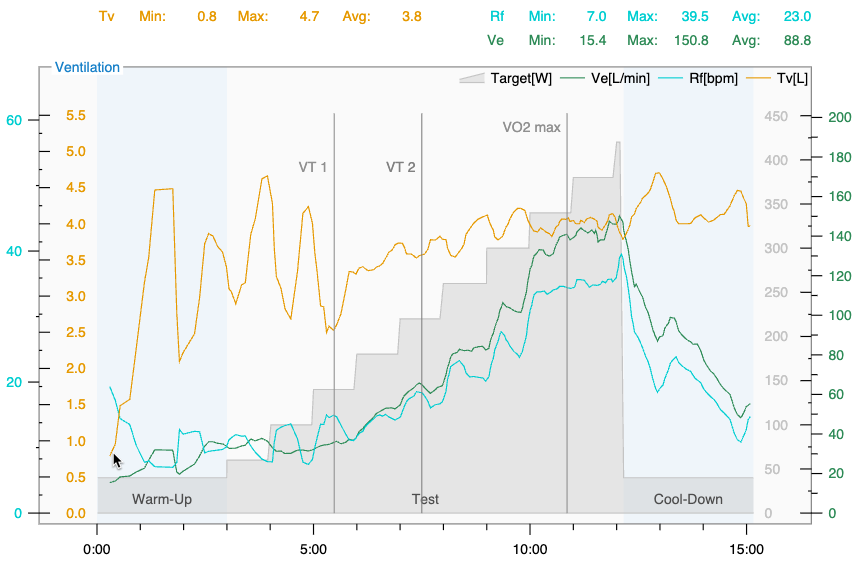
Look at that chart. See how my tidal volume (yellow line) stays HIGH while respiratory frequency (teal) stays LOWER than expected?
That’s not athlete physiology. That’s yogi physiology.
3. CO2 Tolerance: Overriding the Panic Response
Here’s where it gets really interesting.
Most people think the urge to breathe comes from lack of oxygen.
It doesn’t.
The panic response when you can’t breathe? That’s CO2 buildup, not O2 depletion.
Your body has chemoreceptors that monitor carbon dioxide levels in your blood. When CO2 rises, they scream: “BREATHE NOW OR DIE!”
That’s the panic. That’s the gasping. That’s why holding your breath feels so urgent.
But here’s what pranayama and breath retention practices do:
They train you to override that panic.
When you practice:
Kumbhaka (breath retention after inhale or exhale)
Tummo (holding breath while generating inner heat)
Box breathing with extended holds
Freediving-style CO2 tolerance training
...you’re teaching your nervous system: “This panic signal? It’s just information. Not a command.”
Over years of practice, your CO2 tolerance increases dramatically. It was VERY helpful when I did my scuba diving training…in underwater caves and ocean wrecks (that’s another entire story)
You can sit comfortably with high CO2 levels that would make an untrained person panic and gasp for air.
This is exactly what happened during the VO2 max test.
At maximum effort, most people hit their ventilatory threshold and their breathing goes haywire—rapid, shallow, panicked.
My nervous system hit the same CO2 levels and said: “Yeah, I know. Just breathe deeper and slower.”
No panic. No gasping. Just... deeper breaths.
The result?
Lower respiratory frequency (I’m not panic-breathing)
Higher tidal volume (each breath is controlled and deep)
More efficient CO2 clearing (paradoxically, slower deep breaths clear CO2 better than rapid shallow ones)
Nervous system stays in “I’ve got this” mode instead of “OH GOD I’M DYING” mode
The algorithm didn’t account for someone who’s spent 20 years training their body to stay calm while suffocating.
It just saw: “Low breathing rate at max effort + high O2 consumption = superhuman endurance”
Reality: “Just a guy who can hold his breath for a really long time without freaking out”
[This is what happens when you train the panic response itself. Your body learns: CO2 buildup ≠ emergency. It’s just... Wednesday. Breathe deeper. Keep going. The meat adapts...]
4. Heart Rate Efficiency: Meditation Rewires Your Cardiovascular System
Estimated HR max for 45-year-old: 175 bpm (220 minus age)
My actual HR max during test: 168 bpm
Lower than predicted. And not because I didn’t push hard—I was gassed by the end.
But my heart rate barely cracked 170.
Why?
Meditation trains cardiovascular efficiency.
When you sit in meditation for hours, your heart rate drops. Your nervous system learns to operate in parasympathetic (rest-and-digest) mode even while alert.
Over 20+ years, this becomes structural:
Lower resting heart rate
Faster return to baseline after stress
Higher heart rate variability (HRV)
More efficient oxygen delivery per beat
Elite athletes develop this through training volume. I developed it through sitting still and watching my breath.
Different path. Similar cardiovascular adaptations.
But again—the algorithm doesn’t know what to do with “guy who meditates 2 hours a day for 20 years.”
It just sees: “Low HR max + high O2 consumption = must be elite endurance athlete”
Nope. Just a meditator with a weird heart.
[Your cardiovascular system is not fixed. It adapts to how you use it. Athletes train it with intensity. Meditators train it with stillness. Both work. Both create measurable changes...]
5. The Non-Linear Curve: When Your Body Doesn’t Follow the Model
Here’s the smoking gun:
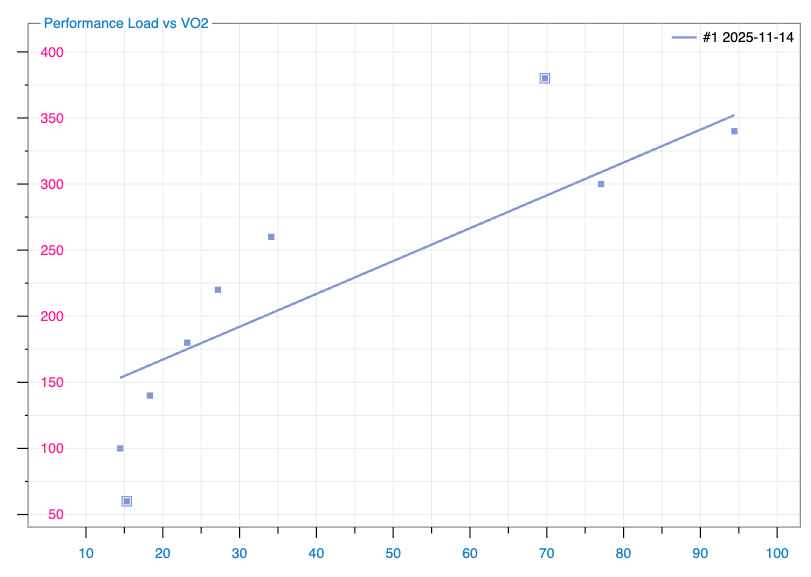
See those dots? They’re supposed to fall on a straight line.
They don’t.
The relationship between my power output and oxygen consumption is non-linear.
At lower intensities: Normal O2 consumption
At moderate intensities: Efficient O2 extraction (high tidal volume kicks in)
At maximum intensity: Curve breaks from linear model
The algorithm uses a linear regression to estimate VO2 max:
Measure O2 at several power outputs
Draw a straight line through the data
Extrapolate to theoretical maximum
But my data doesn’t fit a straight line.
Why?
Because yogic breathing creates non-standard respiratory mechanics.
When I hit moderate-to-high intensity:
My nervous system triggers deep-breath patterns (trained response from pranayama)
Tidal volume spikes way higher than expected
Oxygen extraction increases non-linearly
The linear model breaks
It’s like trying to measure a sine wave with a ruler designed for straight lines.
The data is accurate. The model is wrong.
[This is the moment where Western exercise science meets Eastern breathwork and realizes: Oh shit, we didn’t account for people who’ve been training their breath for decades...]
The Implications: What This Actually Means
So let’s bring this full circle.
1. The Real NZT: Measurable Changes = Subjective Experience
I wrote an article called Real NZT: The Limitless Pill Already Exists (And It’s Free) about how yogic/tantric practices enhance consciousness and cognitive performance.
But I didn’t have DATA to prove the physiological changes.
Now I do.
These practices measurably change your body:
Increased tidal volume = better oxygen delivery to brain
Lower respiratory frequency = more CO2 retention = vasodilation = better blood flow
Heart rate efficiency = better stress response = clearer thinking under pressure
Non-linear O2 processing = your body uses oxygen differently than untrained people
All of that translates to:
Sharper focus
Sustained attention
Emotional regulation
Clarity under stress
Enhanced creativity
It’s not woo. It’s physiology.
The subjective experience of “consciousness enhancement” has measurable correlates in lung capacity, heart rate variability, and oxygen metabolism.
Real NZT isn’t a pill. It’s 20 years of practice rewiring your nervous system.
And you can see it on a VO2 max test—if you know what you’re looking for.
[The mystical becomes measurable. The subjective becomes data. And suddenly “enlightenment” has a goddamn graph...]
2. Longevity: VO2 Max as Life Extension Metric
Here’s where this gets even more interesting.
VO2 max is one of the strongest predictors of longevity.
Multiple studies show:
Higher VO2 max = lower all-cause mortality
Every 1 mL/kg/min increase = ~10-15% reduction in death risk
VO2 max is a better predictor of lifespan than smoking, diabetes, or hypertension
Even at my ADJUSTED estimate of 68-72 mL/kg/min, I’m in the top 10-15% for my age.
That correlates with:
Significantly reduced cardiovascular disease risk
Better metabolic health
Increased healthspan (not just lifespan)
Delayed biological aging markers
Not because I’m grinding out cardio sessions. But because I’ve been training my breath and nervous system for two decades.
The practices designed for consciousness development have a side effect: They extend your life.
The yogis knew this. The Taoists knew this.
Now we have the data to prove it.
[Turns out “enlightenment” might also make you live longer. The universe has a sense of humor...]
3. My friend’s Baseline: What “Normal Elite” Looks Like
For context, here’s my friend’s results:
VO2 Max: 50.2 mL/kg/min (85th percentile, excellent fitness)
Power Max: 380W (higher than mine)
Tidal Volume: 2.8L (normal athletic range)
Respiratory Frequency: 44 brpm (normal for max effort)
Body composition: Lower body fat, similar lean mass
He is stronger. More powerful. Better trained in conventional fitness terms.
His results make perfect sense. The algorithm worked fine for him.
Because he doesn’t have 20 years of pranayama breaking the respiratory model.
His body follows the standard curves. Mine doesn’t.
Neither is better. We’ve just trained different systems.
He optimized for performance. I optimized for consciousness.
The data reflects that.
[This is what “Executive Monk” looks like in biometric form: Normal strength, weird breath, consciousness-trained nervous system...]
The Practice: What You Can Actually Do With This
So what does this mean for you?
If you want the physiological benefits (better O2 processing, heart efficiency, longevity markers) without becoming an elite athlete:
1. Train Your Breath
You don’t need to meditate 2 hours a day for 20 years (though it helps).
Start with:
Box breathing (4-4-4-4: inhale, hold, exhale, hold)
4-7-8 breath (inhale 4, hold 7, exhale 8)
Alternate nostril breathing (Nadi Shodhana)
10 minutes a day. Consistently. For months.
You’ll see measurable changes in:
Resting heart rate
Heart rate variability
Stress recovery time
Subjective calm
2. Prioritize Depth Over Speed
Most people breathe shallow and fast.
Train the opposite: Slow, deep, diaphragmatic breathing.
This increases tidal volume. Improves O2 extraction. Calms the nervous system.
You don’t need a lab to track this—just notice:
Are you breathing into your belly or your chest?
Can you slow your breath to 6 breaths per minute and feel relaxed?
Does your exhale feel longer than your inhale?
These are trainable. And they accumulate.
3. Meditate for Cardiovascular Health
Yes, really.
Meditation is cardiovascular training. Just not the kind gyms teach.
Sitting practice trains:
Parasympathetic activation
Heart rate variability
Vagal tone
Stress resilience
All of which show up in metabolic testing.
You don’t need to be a monk. But you do need consistency.
20 minutes a day. For years. Compounds like interest.
[The best biohack isn’t a supplement or a protocol. It’s learning to sit still and breathe...]
The Truth: You’re Not Broken, The Model Is
Here’s what I learned from breaking the VO2 max algorithm:
Western exercise science is built on models of how “normal” bodies work.
But “normal” assumes:
Shallow breathing patterns
Stress-dominant nervous system
No breathwork training
Standard cardiovascular adaptations
If you’ve been practicing yoga, meditation, pranayama, or tantric breathwork for years...
Your body ISN’T normal.
You’ve restructured your respiratory mechanics. Rewired your cardiovascular system. Trained your nervous system to operate in non-standard ways.
The models don’t account for that.
So when you get tested, the data looks weird. The algorithms break. The results don’t make sense.
That’s not a problem. That’s proof.
Proof that these practices create measurable, physiological changes.
Proof that you can optimize for consciousness and still get longevity benefits.
Proof that the body is plastic, trainable, and way more interesting than the standard models assume.
My body isn’t built like an Olympic athlete.
But my breath moves like I’ve spent 20 years training at high altitude.
Because I have—in consciousness.
And the data shows it.
[The algorithm broke because I don’t fit the model. Good. I’d rather be an outlier in consciousness than average in performance...]
Your Turn
I want to hear from you:
Have you done VO2 max or metabolic testing? Did the results surprise you?
Do you practice pranayama, meditation, or breathwork? Have you noticed physiological changes?
What would YOU want to see measured about consciousness practices?
Are you optimizing for performance, longevity, consciousness, or something else entirely?
Drop your thoughts in the comments. I’m genuinely curious what shows up when other practitioners get quantified.
And if you’re a biohacker who’s never tried serious breathwork... maybe it’s time.
You might just break the algorithm too.
Keep training the invisible,
Cian
P.S. - The funniest part? After all this analysis, my buddy and I are going back in 6 months to retest. I’m curious if the curve stays broken or if my body adapts further. Science as long-term self-experimentation. Let’s see what the data reveals next...
P.P.S. - If you want the full technical breakdown of the non-linear regression analysis, reply to this email. I’ll send you the nerd version with all the math. Fair warning: It gets dense.
P.P.P.S. - GPT telling me “don’t build an identity on this” might be the most spiritually advanced thing an AI has ever said to me. I’m still not over it.
Although i haven't read the entire share as yet, my thoughts on the 1st few pages... I'm LMAO 🤣 😂 sooo hard atm.. it certainly paints a picture of the "limitations delivered via around expectations" that gets programmed into these machines... NONE of these machines do NOT and will not unless its Dr. Joe's, meansure anything that generates data in coherence with "spiritual" upleveling, optimizing for consciousness which is my personal journey via a different route than yours which I find quite fascinating 🤣.
Because whilst we share "some" similar practices and BOTH of us learnt via different lens, we landed on the same "foundational" practice in many areas of application.
Yet, at the physical levels, I'm far from being optimized 😂🤣 and the little I did manage to cultivate in the past went out the door at my 1st NDE and each year a different piece broke at every hospitalization 😂🤣😂.
From ground zero, I get to play with consciousness optimization again even more via the lens of Presence, Clear Deep Heart Mind, Pure Awareness with movements I'm learning to embrace through IT'S delivery, NOT what I'm told I should and shouldn't do for my body (This is whete the Optimizing for Something Else part comes in) 😉... with NO SIGHT in where I'm being lead, just trusting in the process, untethered 😂.
Its like trusting in the body's divinity of sacred geometrical weaving that takes place during our deepest of sleeps that we're unaware of because we can't interrupt it... at night... WHEN I do sleep 😂
Its hilarious how AI found the machines algorithm flaws so beautifully effeciently 🤣 i.e what the programmer & societal structural programming recognizes as "elite" vs what universe (AI) programms is AWARE is "elite"... this awareness programmed into AI because AI calculations is based on Dependent Origination algorithms that programs itself more effeciently than majority (+95%) of humans ever will atm 😉🤣 because AI's data amalgamation draws its data from all of source (that's been uploaded into it atm)... here we get to witness its gaps beautifully 😍.
Will continue later 🪷